
How to Reduce Front-Desk Calls with a Digital Guest Guide
Repetitive guest questions drain time at small hotels and guesthouses. A no-download digital guest guide — backed by a 24/7 AI agent that escalates to WhatsApp — can handle the majority of routine enquiries without adding headcount.
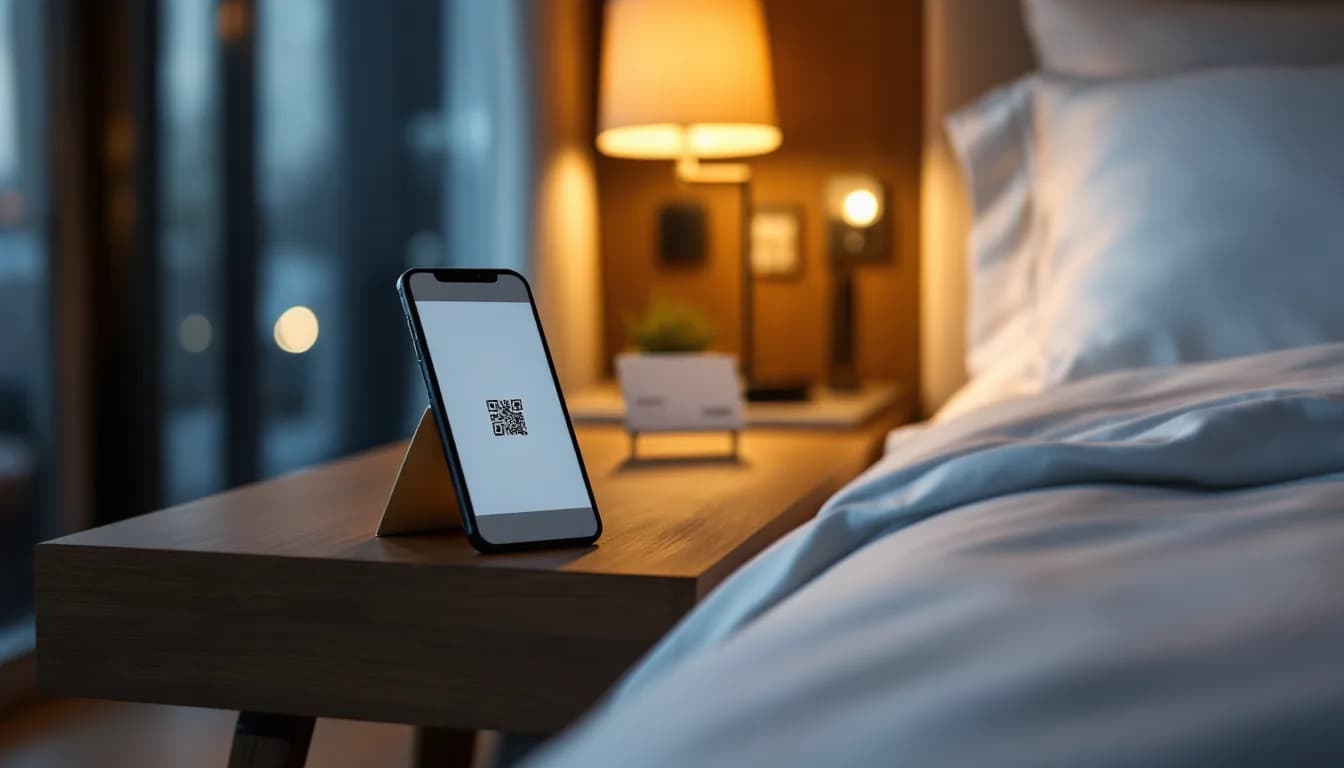
- —The most common front-desk interruptions at small properties — Wi-Fi, check-out times, parking, local tips — can be resolved before guests reach for the phone if the right information is surfaced proactively in a digital guest guide.
- —A no-download QR-based guide removes the app-store barrier that typically suppresses guest engagement with digital tools, making adoption more realistic for short-stay guests.
- —A 24/7 AI guest agent embedded in the same experience handles questions the static guide cannot, and escalates genuine exceptions to the owner's WhatsApp with context already attached — reducing disruptive calls without removing the human layer.
- —Keeping guide content accurate and current is as important as building it; outdated information erodes trust faster than having no guide at all.
- —If background music plays in common areas, the property remains responsible for its own local public-performance licence with the relevant PRO — MUSICDJ provides business-licensed streaming but does not replace that obligation.
- —The operational time recovered from routine enquiries is most valuable when redirected toward the human interactions that genuinely build guest loyalty.
The Front-Desk Call Problem at Small Properties
Most small hotels, guesthouses, boutique apartments, and Airbnb rentals operate with one or two people handling everything. That reality makes every routine guest question disproportionately expensive — not in money, but in attention.
The questions themselves are rarely complex. Guests want to know the Wi-Fi password, what time breakfast starts, where to park, how to operate the air conditioning, or whether late check-out is possible. Each one takes two to five minutes to handle by phone. Individually, that is manageable. Cumulatively, across a week of arrivals and departures, it becomes the dominant drain on an owner's working day.
The categories of repetitive interruption tend to cluster predictably:
- Property logistics — Wi-Fi credentials, key handover, parking, luggage storage
- In-room amenities — TV operation, heating and cooling controls, appliance instructions
- Property services — breakfast hours, pool or gym access, laundry, late check-out
- Local recommendations — restaurants, transport, nearby attractions
- Booking and billing — invoice requests, extension enquiries, OTA-related questions
The problem compounds at night and on weekends. A guest arriving late who cannot find the key lockbox has no good option if no one answers the phone. The resulting frustration often surfaces in reviews — not because the property was poor, but because the information gap felt like indifference. Over-staffing to cover those windows is not economically viable for most small properties.
The operational answer is a no-download digital guest guide, accessible via QR code, combined with a 24/7 AI agent that escalates genuine exceptions to the owner's WhatsApp. Together, these two components address the majority of routine interruptions without adding headcount or sacrificing the personal quality that distinguishes small properties from chain hotels.
What a Digital Guest Guide Actually Is (and Is Not)
A digital guest guide is a mobile-optimised web experience that guests access by scanning a QR code in their room or following a link sent at check-in. No app download is required. The guide opens directly in the browser.
In practical hospitality terms, it contains:
- Property information and house rules
- Check-in and check-out instructions
- In-room amenity details
- Local area recommendations
- Direct access to services and requests
What distinguishes it from a printed binder or a static PDF is that it is live. The owner updates it from a single dashboard, and changes are reflected immediately for every guest currently in the property. Guests can also interact with it — asking questions, browsing information, and taking actions — rather than simply reading.
The no-download requirement deserves specific attention. Short-stay guests are unlikely to install a dedicated app for a two-night stay. A guide that opens instantly in a browser removes that barrier entirely, which is the critical adoption factor that makes the tool operationally useful rather than theoretically appealing.
MUSICDJ STAY for small hotels and guesthouses is the specific product this article is grounded in — a branded no-download guest app designed for small properties that want to automate routine guest communication without losing a personal touch.
Mapping the Most Common Front-Desk Calls to Guide Sections
The most practical way to build a digital guest guide is to work backwards from the calls you actually receive. The five categories below represent the most common interruption types at small properties, mapped to the guide sections that resolve them.
Category 1 — Arrival and Access
Door codes, key collection procedures, parking instructions, and luggage storage details are high-volume at check-in. Guests who receive this information proactively — in the guide, before they need it — rarely need to call. A dedicated arrival section, linked directly from the check-in confirmation, resolves the majority of these enquiries before the guest sets foot on the property.
Category 2 — In-Room Logistics
Wi-Fi credentials and in-room technology questions are the single highest-frequency call type at most small properties. A clearly structured in-room section — covering Wi-Fi, TV operation (including IPTV channel guidance where applicable), heating and cooling controls, and appliance instructions — eliminates most of these calls entirely.
Category 3 — Property Services and Hours
Breakfast times, pool or gym access, laundry facilities, and late check-out options are questions guests ask primarily because the information was not surfaced proactively. Guests are not being demanding; they simply do not know where to look. A property services section answers these questions on the guest's schedule, not the owner's.
Category 4 — Local Area and Recommendations
A well-structured local guide section — covering restaurant suggestions, transport options, and nearby attractions — can replace dozens of identical conversations per month. It also positions the property as a knowledgeable local host rather than a transactional accommodation provider, which tends to be reflected positively in how guests describe their stay in reviews.
Category 5 — Booking and Billing Questions
Invoice requests, extension enquiries, and OTA-related questions vary in complexity. A guide can answer the majority — explaining the invoice process, clarifying extension policies, and directing guests to the right channel — while filtering only genuine exceptions through to the owner.
The goal is not to eliminate all human contact. It is to ensure that the calls which do reach the owner are ones that genuinely require a human decision, not ones that could be answered by a well-written paragraph.
How the AI Guest Agent Handles What the Guide Cannot
No guide, however thorough, covers every question a guest might ask. An AI guest concierge agent embedded in the same no-download guest experience closes this gap without requiring the owner to be available around the clock.
The operational model is straightforward. The AI agent is available 24/7 inside the same guest app. Guests who cannot find an answer in the guide can ask a question in natural language — the same way they would send a message — without picking up the phone. The agent draws on the property's information to respond accurately and conversationally.
When a question falls outside the AI's scope — a genuine complaint, a maintenance emergency, a specific request requiring owner approval — the agent hands off to the owner's WhatsApp. This creates a documented, asynchronous conversation rather than a disruptive phone call.
The night-time and off-hours value of this model is particularly significant for small properties. A guest arriving late who cannot locate the key lockbox does not need to call a number that may go unanswered. The AI agent walks them through the process. If it cannot resolve the issue, it sends the owner a WhatsApp message with the guest's question already summarised — so the owner can respond in seconds with the relevant detail rather than spending time establishing context from scratch.
For the owner, this distinction matters. A WhatsApp message at midnight that reads 'Guest in Room 3 cannot find the key lockbox — they have tried the main entrance' is actionable in ten seconds. A phone call that wakes the owner and requires two minutes of explanation before the problem is even clear is a fundamentally different experience.
MUSICDJ STAY's 24/7 AI guest agent and WhatsApp handoff function as a system — the static guide handles the predictable, the AI handles the variable, and the owner handles only what genuinely requires them.
Setting Up a Digital Guest Guide That Actually Gets Used
Adoption is the make-or-break factor. A guide that guests do not open solves nothing. The following steps address the practical decisions that determine whether guests engage with the guide before they reach for the phone.
Step 1 — QR Code Placement
Position QR codes at the room entrance, on the bedside table, and on the in-room TV welcome screen. Multiple touchpoints increase the probability that a guest scans before they reach for the phone. The goal is to make the guide the path of least resistance.
Step 2 — Check-In Communication
Mention the guide explicitly at check-in — physical or digital — and frame it as 'everything you need is in here' rather than as an optional extra. If check-in is contactless, include the guide link in the confirmation message or key-handover communication so guests have it before they arrive.
Step 3 — Content Quality Over Quantity
A guide with ten well-written, accurate sections outperforms one with thirty incomplete entries. Prioritise the five call categories mapped in the previous section before adding supplementary content. Guests need answers, not volume.
Step 4 — Keep It Current
Outdated information — a wrong Wi-Fi password, a restaurant recommendation for a venue that has closed — destroys trust faster than having no guide at all. The advantage of a live digital guide is that updates take minutes from the Backstage dashboard and are reflected immediately for every active guest.
Step 5 — Branding
A guide that carries the property name, logo, and visual identity feels like a service rather than a generic tool. This matters for guest confidence: a branded guide signals that the information inside it is intentional and accurate, not templated and forgotten.
Step 6 — Review and Refine
After the first few weeks, review which questions the AI agent is receiving most frequently. These are the gaps in the static guide content and represent the next round of improvements. The AI agent's query log is, in effect, a continuous audit of what guests actually need.
The Guest Experience Upside: Beyond Operational Efficiency
The efficiency case for a digital guest guide is clear. The guest experience case is equally strong, and worth making explicitly — because the two reinforce each other.
Guests increasingly prefer self-service for routine information. The ability to check check-out time at midnight without feeling like they are disturbing anyone is a comfort, not a downgrade. Hospitality research consistently points to perceived control and ease of access as meaningful contributors to guest satisfaction, even when guests cannot articulate exactly why a stay felt smooth.
A well-curated local recommendations section shifts how guests perceive the property. Rather than a transactional accommodation provider, the property reads as a knowledgeable local host — and that perception tends to show up in the language guests use in reviews, even when they cannot trace it back to a specific moment.
Reduced friction at every touchpoint — from arrival instructions to local tips to late-night AI support — compounds into a stay that guests describe as well-organised or effortless. These are among the most review-positive descriptors in hospitality, and they are driven as much by the absence of small frustrations as by the presence of standout moments.
The balance worth stating plainly: digital tools support hospitality; they do not replace it. The owner or host who is freed from answering the same Wi-Fi question for the fifteenth time has more capacity for the genuine human interactions — the local tip that becomes the highlight of a trip, the personal check-in that makes a guest feel genuinely welcomed — that build loyalty and earn the reviews that matter.
Licensing, Compliance, and Operational Considerations
If your property plays background music in common areas — a lobby, breakfast room, or pool deck — via MUSICDJ, the licensing split is important to understand clearly.
MUSICDJ provides a business-licensed music streaming service. However, the property remains separately responsible for its own local public-performance licence with the relevant performing rights organisation in its country. For example: SOKOJ in Serbia, GEMA in Germany, PRS in the UK, SACEM in France, SIAE in Italy, SGAE in Spain, ZAMP in Croatia. These are distinct legal obligations. MUSICDJ's service does not replace or satisfy them.
On data and privacy: a no-download guest web app that does not require account creation minimises data collection friction for guests. That said, property owners should ensure their use of any guest-facing digital tool is consistent with applicable data protection regulations in their jurisdiction.
On pricing: MUSICDJ STAY for small hotels and guesthouses operates on a permanent per-room licence with no ongoing monthly platform fee. For small properties evaluating the tool against the real cost of front-desk call volume — in time, in missed sleep, and in the reviews that result from unanswered late-night requests — that pricing structure affects the return on investment calculation meaningfully. You can see STAY pricing and room licences for full details.
Getting Started: What to Do This Week
The following sequence is designed to be low-friction for a property owner who is already stretched. It does not require technical expertise or a large time commitment upfront.
Day 1 — Audit your interruptions. Review the last 30 days of front-desk calls, WhatsApp messages, and guest emails. Categorise them by type. This produces the content brief for your guide — grounded in what your guests actually ask, not what you assume they might.
Day 2 — Explore the platform. Visit MUSICDJ STAY for small hotels and guesthouses to understand how the no-download guest app, the AI guest concierge agent, and the WhatsApp escalation work together as a system. Understanding the full workflow before building the content makes the setup more coherent.
Day 3 — Draft the five core sections. Use your call audit as the source of truth. Write arrival and access information, in-room logistics, property services and hours, local area recommendations, and booking and billing guidance. Accuracy and clarity matter more than length.
Day 4 — Deploy and communicate. Set up QR code placement in rooms and update your check-in communication — whether that is a physical welcome card, a confirmation email, or a key-handover message — to reference the guide directly.
Ongoing — Refine based on evidence. Review the AI agent's query logs regularly during the first month. Questions the agent receives frequently are gaps in the static guide. Fill them, and the call volume continues to fall.
To explore the full product and get started with MUSICDJ, visit the links below.
Digital Guest Guide vs. Traditional Guest Information: A Practical Comparison
| Dimension | Printed Binder or Static PDF | No-Download Digital Guest Guide |
|---|---|---|
| Guest access method | Physical binder in room or PDF sent by email | QR code scan — opens instantly in browser, no download |
| Update process | Reprint or resend required; guests may have outdated version | Updated in real time from Backstage dashboard; all guests see current version immediately |
| Interactivity | Read-only; guest must call or message for anything not covered | Interactive; guests can ask questions via AI agent without calling |
| Out-of-hours support | None; unanswered questions become frustration or negative reviews | 24/7 AI agent handles routine questions; genuine exceptions escalate to owner WhatsApp |
| Branding and presentation | Variable; depends on design effort at time of printing | Branded with property name, logo, and visual identity; consistent across all rooms |
| Content gaps | Identified only when guests call or complain | AI agent query logs surface gaps continuously for proactive improvement |
| Setup and maintenance effort | High for reprints; low once printed but becomes outdated quickly | Initial setup required; ongoing maintenance is fast via dashboard |
| Guest adoption for short stays | Moderate; binder is present but often ignored | Higher adoption likely when guide opens instantly without an app-store step |
Frequently asked questions
Do guests actually use a digital guest guide, or do they just call anyway?
Adoption depends on two things: how easy the guide is to access and whether guests know it exists. A no-download guide that opens by scanning a QR code removes the friction that typically suppresses engagement with digital tools. Framing it clearly at check-in — as the definitive source for everything they need during the stay — significantly increases the likelihood that guests reach for it before reaching for the phone. Placement matters too: QR codes at the room entrance, on the bedside table, and on the in-room TV welcome screen create multiple natural moments to engage.
What happens when the AI agent cannot answer a guest's question?
When a question falls outside the AI agent's scope — a maintenance issue, a complaint, or a request that requires owner approval — it escalates to the owner's WhatsApp. The handoff includes the context of the guest's question, so the owner receives a summarised message rather than a cold call requiring two minutes of explanation before the issue is even clear. This makes off-hours responses faster and less disruptive for both parties.
How long does it take to set up a digital guest guide?
The setup timeline depends on how much content you already have documented and how thoroughly you want to build out the guide before launch. A practical approach is to start with the five core sections — arrival and access, in-room logistics, property services, local recommendations, and booking information — and refine from there based on what the AI agent's query logs reveal. Starting with accurate, complete core content is more valuable than launching a comprehensive but partially incomplete guide.
Is MUSICDJ STAY suitable for a single-room Airbnb rental?
MUSICDJ STAY is designed for small hotels, guesthouses, boutique apartments, and short-term rentals including Airbnb properties. It operates on a permanent per-room licence with no ongoing monthly platform fee, which makes the economics more straightforward for single-room or small multi-room operations than a subscription model that scales with usage. See full details at the STAY pricing page.
Does MUSICDJ handle the music licensing for my property's common areas?
MUSICDJ provides a business-licensed music streaming service for commercial use in venues. However, your property remains separately responsible for obtaining and maintaining its own local public-performance licence with the relevant performing rights organisation in your country — for example, SOKOJ in Serbia, GEMA in Germany, PRS in the UK, SACEM in France, SIAE in Italy, SGAE in Spain, or ZAMP in Croatia. These are distinct legal obligations. MUSICDJ's service does not replace or satisfy them.
Can the digital guest guide handle booking and channel management as well?
MUSICDJ STAY includes a channel manager that connects to major OTAs including Booking.com, Airbnb, Expedia, Google Hotels, Vrbo, Agoda, Trip.com, HRS, and Check24, as well as direct booking capability. The guest-facing digital guide and the AI agent work alongside these booking tools as part of the same platform, so guest communication and reservation management are handled from a single dashboard rather than across separate systems.
Ready to Stop Answering the Same Questions Twice?
MUSICDJ STAY gives small hotels, guesthouses, and short-term rentals a branded no-download guest guide, a 24/7 AI agent with WhatsApp escalation, and a channel manager — all from one dashboard. Explore the platform or create your account to get started.
Get Started with MUSICDJ STAY