
Digital Guest Directories for Hotels: Replace the Printed Binder
The laminated binder on the guestroom desk is a maintenance liability dressed up as a hospitality asset. Here is the practical, operations-first case for retiring it in favour of a digital hotel directory that stays current, reduces staff workload, and keeps you connected to every guest throughout their stay.
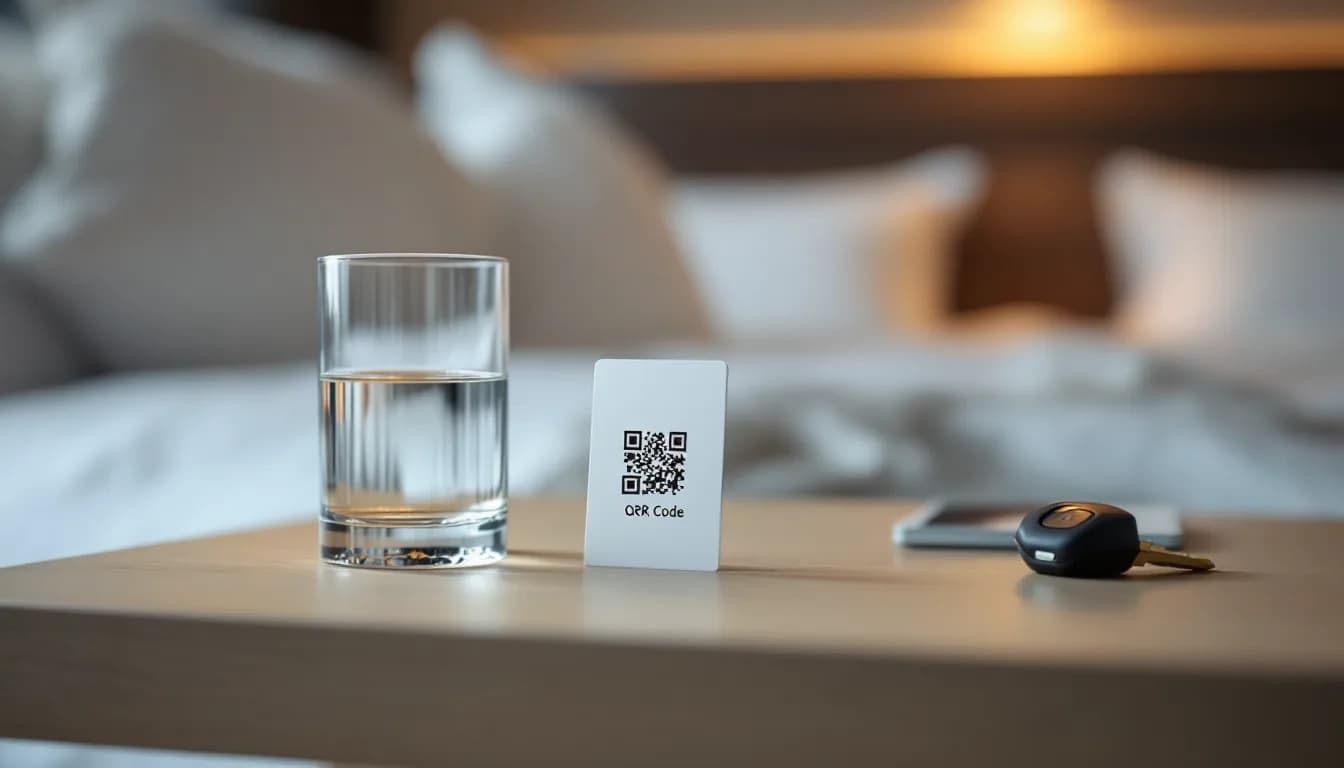
- —The printed in-room binder carries hidden operational costs — reprinting, laminating, and redistributing to every room every time information changes.
- —A digital hotel directory is a guest-facing web app accessed via QR code, with no download or account creation required.
- —One edit in the management dashboard updates every room instantly, eliminating the per-change labour of the printed workflow.
- —A 24/7 AI guest agent can handle routine questions and escalate to the owner's WhatsApp, reducing front desk call volume at any hour.
- —MUSICDJ STAY uses a one-time per-room licence with no monthly platform fee, making total cost of ownership predictable for small operators.
- —MUSICDJ background music is licensed for business use, but properties remain responsible for their own local public-performance licence (SOKOJ, GEMA, PRS, SACEM, or equivalent).
- —Transitioning from a printed binder to a digital directory is a process measurable in hours, not weeks, for a small property.
The Printed Binder Is Costing You More Than You Think
Every guestroom in your property probably has one: a laminated folder, a ring-bound binder, or a neat plastic sleeve sitting on the desk or the bedside table. It looks organised. It feels professional. And it is, quietly, one of the more persistent operational drains in small hospitality.
Consider what maintaining that binder actually requires. Every time your breakfast hours shift, a local partner restaurant closes, a room rate changes, or your Wi-Fi password is updated, someone on your team must reprint the relevant page, re-laminate it if your property laminates, and physically visit every room to swap the old version for the new one. Multiply that task across every change event across a full year — seasonal menus, maintenance closures, updated check-out policies, new local recommendations — and the cumulative staff hours are significant.
The guest experience cost is less visible but equally real. A guest who finds an outdated Wi-Fi password, a phone number that no longer connects, or a reference to a restaurant that closed two seasons ago does not think 'the binder is out of date.' They think the property is not paying attention. That impression forms before they have even unpacked.
This article is written for independent hotel owners, guesthouse managers, boutique property operators, and Airbnb hosts who currently rely on printed in-room materials and are evaluating a practical, low-friction upgrade. The case for a digital hotel directory is not primarily a technology argument — it is an operations and guest experience argument, and the numbers tend to make themselves.
What a Digital Hotel Directory Actually Is (and Is Not)
A digital hotel directory is a guest-facing web app, typically accessed by scanning a QR code in the room, that surfaces everything the printed binder used to contain:
- House rules and check-in/check-out instructions
- Wi-Fi credentials
- Room features and how to use in-room equipment
- Dining options, amenity hours, and service availability
- Local area guide and recommendations
- Emergency contacts
- Upsells, extensions, or special requests
The critical distinction from a traditional hotel mobile app is the absence of friction. Guests open the directory in any mobile browser. There is no app store visit, no account creation, no download, and no password to remember. It works on any smartphone, regardless of operating system or storage space.
It is also categorically different from a PDF sent by email. A PDF is static — it goes out of date the moment something changes, and it offers no interactivity. A digital guest directory is a live document: update it once and every guest accessing it from that moment forward sees the current version.
For properties using MUSICDJ STAY guest app, the directory can also surface dynamic content — what music is currently playing in the lobby, a direct prompt to leave a Google review, or a link to contact the property — extending the guest relationship well beyond the four walls of the room.
The Operational Case: One Update, Every Room, Instantly
The operational argument for a digital hotel directory is straightforward, but it is worth making concrete.
When your breakfast service moves from 7:30 to 8:00, or the pool closes for a week of maintenance, or your recommended taxi number changes, you log into your management dashboard, edit the relevant section, and save. Every guest in every room sees the updated information the next time they open the directory. There is no printing queue, no laminating machine, no stack of rooms to visit.
Contrast that with the printed workflow:
- Identify what has changed and which pages are affected.
- Rewrite and reformat the content.
- Print the new pages — on the correct paper, in the correct format.
- Laminate if your property laminates.
- Visit every occupied and unoccupied room to replace the old version.
- Dispose of the outdated materials.
For a property with twenty rooms and a dozen change events per year, that process consumes a meaningful portion of a staff member's working time — time that could be spent on guest-facing service.
Seasonal properties and short-term rentals face this challenge acutely. When a property turns over between guest stays, information often needs to be reset or refreshed. A digital directory makes that reset a dashboard task rather than a room-by-room physical operation.
The downstream benefit is a measurable reduction in routine front desk calls. When Wi-Fi credentials, check-out times, and local pharmacy locations are clearly available in the directory, guests find the answers themselves. A well-structured digital directory functions as a 24/7 self-service concierge, fielding the questions that currently interrupt your team at all hours.
The Guest Experience Case: Information When and Where They Need It
Guest behaviour has shifted. The default response to an unanswered question is no longer to pick up the in-room phone — it is to reach for a smartphone. A digital hotel directory meets guests in that moment, on the device they are already holding, without asking them to learn anything new.
A no-download web app removes every installation barrier. There is no learning curve. It works on the guest's existing browser, on any device, in any language the property chooses to support. The experience is immediate.
For properties using MUSICDJ STAY, the directory includes access to an AI guest concierge agent that handles common questions around the clock and escalates to the owner's WhatsApp when a question requires human judgment. A guest asking about late check-out at 11 pm gets an answer without waking anyone up. A guest with a genuine problem gets a real person when it matters.
The directory is also a natural point for review generation. A prompt or direct link to your Google review page, surfaced at the right moment in the guest journey — after a positive check-in interaction or the day before departure — is substantially more effective than a printed card left on the desk. The guest is already on their phone. The friction between intention and action is close to zero.
Finally, a digital directory reinforces your property's brand identity in a way a generic laminated sheet cannot. Your logo, colour palette, tone of voice, and photography all carry through to every screen, every room, every stay.
Direct Bookings and the Channel Manager Connection
A digital guest directory is not only an in-stay tool. It is a touchpoint in a longer commercial relationship.
A guest who has a frictionless in-stay digital experience — information at their fingertips, questions answered instantly, no friction at any point — is more likely to return directly rather than through an OTA. Every direct booking avoids an OTA commission, and those commissions accumulate meaningfully over a full year for a small property.
For properties on MUSICDJ STAY, the platform connects to major OTA channels — Booking.com, Airbnb, Expedia, Google Hotels, Vrbo, Agoda, Trip.com, HRS, and Check24 — via an integrated channel manager, while simultaneously enabling direct bookings. The guest directory can surface a 'Book Direct Next Time' prompt at the appropriate moment in the stay, creating a low-pressure, high-relevance invitation to bypass the OTA on the next visit.
The STAY pricing model is designed for small operators: one permanent licence per room, one device per room, with no recurring monthly platform fee. Total cost of ownership is predictable from day one. The upfront licence cost is offset by staff time saved, reprint costs eliminated, and incremental direct bookings captured over time — a compounding return rather than a flat expense.
In-Room Entertainment: TV and Music as Part of the Guest Directory Ecosystem
A digital guest directory does not have to stand alone. For properties that want a fuller in-room experience, it sits naturally alongside in-room television and background music managed through the same platform.
MUSICDJ STAY includes a branded in-room guest TV experience, giving small independent hotels a feature set that was previously the preserve of larger branded properties. Guests see a consistent, property-branded interface rather than a generic cable menu.
Background music in common areas — the lobby, bar, breakfast room, or courtyard — is managed through the same Backstage dashboard, with in-room background music by zone, scheduling, and day-parting available across the property. The guest directory can surface a 'Now Playing' feature, connecting the in-room digital experience to the atmosphere guests encounter in shared spaces.
A note on licensing that every operator should understand clearly: MUSICDJ background music is licensed for business use, but your property remains responsible for obtaining and maintaining its own local public-performance licence — whether that is SOKOJ, GEMA, PRS, SACEM, or the relevant performing rights organisation in your country. These are separate obligations. MUSICDJ's business licence does not replace or remove them. If you are unsure which PRO applies to your property, contact them directly before streaming music in any public-facing space.
Digital signage for hotels — menus, promotions, and AI-generated visuals on venue screens — is also managed from the same Backstage dashboard, reducing the number of vendor relationships and support contacts the operator needs to maintain.
How to Transition: A Practical Step-by-Step for Small Properties
The move from a printed binder to a digital hotel directory is more straightforward than most operators expect. Here is a practical sequence.
Step 1 — Audit the existing binder
List every category of information it contains. Note what changes most frequently. Review your front desk call log, if you keep one, to identify the five questions guests ask most often. Those five answers should be the first thing guests find in the digital directory.
Step 2 — Map content to digital sections
Translate your binder categories into a logical digital structure. Do not try to recreate the binder page for page — reorganise around how guests actually look for information, not how the binder was originally assembled.
Step 3 — Set up the platform and populate content
For MUSICDJ STAY, this is done through the Backstage dashboard. The AI menu generation feature can accelerate content creation for dining and amenity sections, reducing the time required to populate the directory from scratch.
Step 4 — Place QR codes strategically
Multiple entry points increase the likelihood that guests actually use the directory. Place QR codes on the room door, the desk card, the welcome card, and at the front desk. A guest who misses one will encounter another.
Step 5 — Brief the team
Every staff member who interacts with guests should know what the directory contains and be comfortable directing guests to it for self-serve queries. The directory reduces call volume only if the team actively points guests toward it.
Step 6 — Review and iterate
After the first few weeks, review guest feedback and front desk call patterns. Identify gaps in the directory content and update accordingly. The ease of updating is the entire point — use it.
Choosing the Right Digital Directory Solution for a Small Property
Not all digital directory solutions are equally suited to small independent operators. When evaluating options, apply these criteria:
- No-download guest access — any solution that requires guests to install an app introduces friction that will reduce adoption.
- Ease of content updates — operators should be able to update any section without technical skills or vendor involvement. Solutions that require a support ticket to change a phone number negate the operational benefit.
- Transparent pricing — per-edit fees or unpredictable monthly costs make budgeting difficult for small properties. A permanent per-room licence with no platform fee is easier to plan around.
- Integration with other in-property systems — a directory that lives in isolation from your channel manager, in-room TV, and music platform means managing multiple vendor relationships and multiple dashboards.
- Scalability — whether you operate one apartment or a twenty-room guesthouse, the platform should accommodate your current size and leave room to grow.
The concern that technology is too complex for small independent operators is understandable but increasingly outdated. Modern platforms are designed for non-technical users. Setup time for a small property should be measured in hours, not weeks.
MUSICDJ STAY guest app is purpose-built for small hotels, guesthouses, serviced apartments, and Airbnb rentals — combining the digital guest directory, in-room TV, background music, channel manager, and AI guest agent in a single dashboard with a pricing model designed for independent operators.
To see the full product detail, visit /stay. To begin setup for your property, get started with MUSICDJ.
Printed In-Room Binder vs Digital Hotel Directory
| Feature | Printed Binder | Digital Hotel Directory |
|---|---|---|
| Content updates | Reprint, re-laminate, redistribute to every room | Edit once in dashboard; all rooms updated instantly |
| Guest access method | Physical document in room | QR code scan; opens in mobile browser, no download |
| Accuracy over time | Degrades with every change event | Always current as of last edit |
| Staff time per update | High — physical visit to every room required | Minimal — dashboard edit takes minutes |
| Printing and materials cost | Recurring — paper, ink, laminate | None after initial setup |
| Brand consistency | Limited to print quality and design | Logo, colour scheme, and tone applied throughout |
| Review generation | Printed card, easily ignored | Direct link or prompt surfaced at the right moment |
| 24/7 guest support | None — guest must call front desk | AI guest agent handles routine queries at any hour |
| Direct booking prompt | Not possible | Can surface 'Book Direct' prompt during the stay |
| Update frequency barrier | High — each change is a manual task | None — update as often as needed at no extra cost |
Frequently asked questions
Do guests need to download an app to use a digital hotel directory?
No. A properly built digital guest directory opens in any mobile browser via a QR code scan. There is no app store visit, no account creation, and no download required. Guests access it on whatever device they already have, without any setup on their part.
How long does it take to set up a digital hotel directory for a small property?
For a small property using a platform designed for non-technical operators, initial setup is typically measured in hours rather than days or weeks. The main time investment is populating the content — translating your existing binder categories into digital sections. AI-assisted content tools can accelerate this for dining and amenity sections.
Does MUSICDJ STAY handle our music licensing obligations?
MUSICDJ background music is licensed for business use, which covers the platform's streaming rights. However, your property remains separately responsible for obtaining and maintaining its own local public-performance licence — such as SOKOJ, GEMA, PRS, SACEM, or the relevant PRO in your country. These are distinct obligations, and MUSICDJ's licence does not replace them.
Can a digital guest directory help generate more direct bookings?
Yes, indirectly and directly. A frictionless in-stay digital experience builds the kind of guest confidence that makes direct return bookings more likely. More directly, the directory can surface a prompt inviting guests to book directly on their next visit, bypassing OTA commission costs. For MUSICDJ STAY properties, this sits alongside an integrated channel manager that connects to the major OTAs while also enabling direct bookings.
What happens when information changes — do I have to update every room separately?
No. That is the central operational advantage of a digital hotel directory. You edit the content once in your management dashboard and every guest accessing the directory from that point forward sees the updated information. There is no per-room update process and no physical redistribution required.
Is a digital hotel directory suitable for Airbnb rentals and serviced apartments, or only traditional hotels?
It is well suited to any short-stay accommodation where guests need property information and self-serve support. Airbnb hosts and serviced apartment operators often find it particularly valuable because the property turns over frequently between guests and information needs to be refreshed or reset regularly — a task that is a dashboard edit rather than a physical process with a digital directory.
Ready to Retire the Binder?
MUSICDJ STAY gives small hotels, guesthouses, apartments, and Airbnb rentals a no-download digital guest directory, in-room TV, background music, channel manager, and AI guest agent — all managed from one dashboard, with a one-time per-room licence and no monthly platform fee.
Get Started with MUSICDJ