
Restaurant Technology Trends 2026: What's Worth Adopting
A practical evaluation of the ambient, digital, and AI technology layers that genuinely improve guest experience in 2026 — and the over-engineered distractions that are not worth the budget.
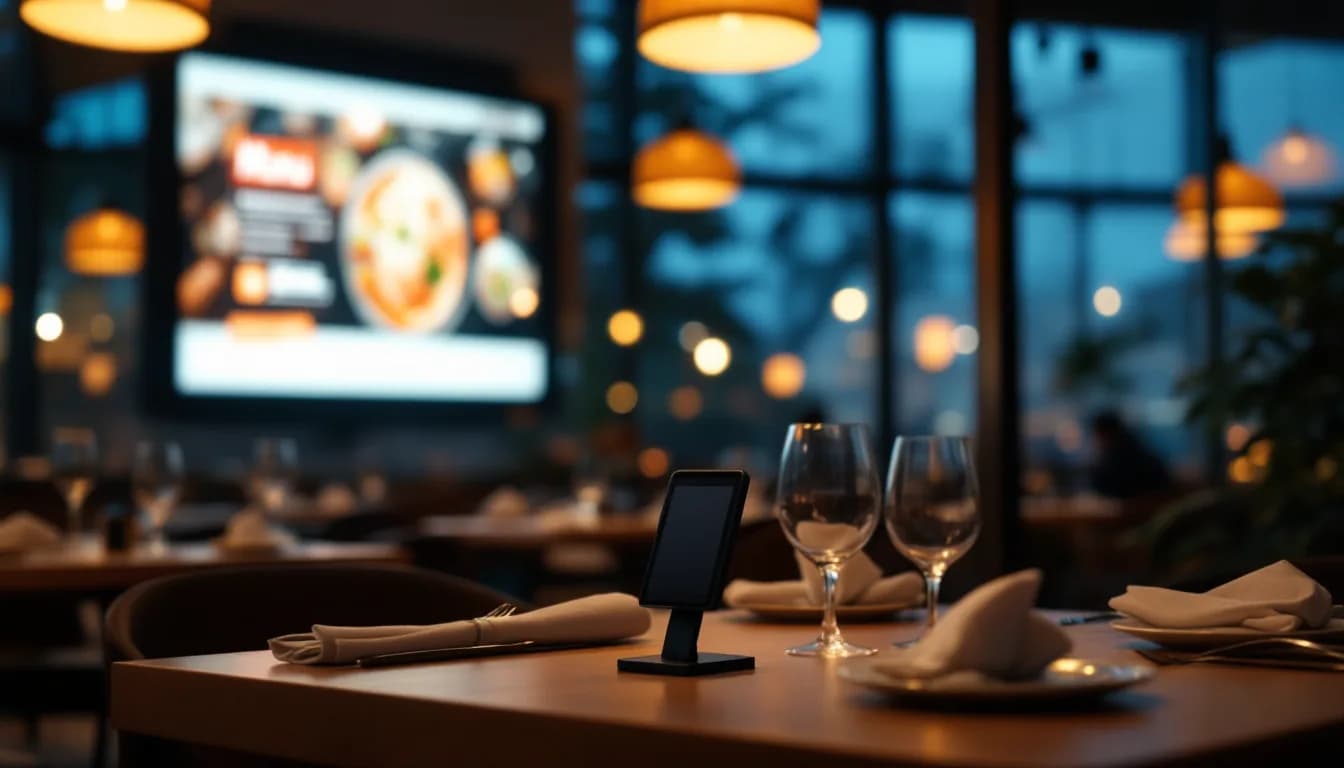
- —Separate technology that genuinely improves guest experience from technology that only improves operator workflows before making any budget decision.
- —Background music with zone control and day-parting is the highest-impact, lowest-friction investment available to any hospitality venue.
- —A licensed business music streaming platform and the venue's own public-performance PRO registration are parallel obligations — one does not replace the other.
- —Digital signage only earns its cost when content is actively scheduled and managed; unmanaged screens running stale content are an operational liability.
- —AI is deployable today for bounded content tasks — jingles, visuals, menu copy — but is not yet reliable for judgement-heavy, guest-facing roles.
The Evaluation Framework: Three Questions That Cut Through the Noise
Most technology marketed to restaurants in 2026 is engineered to make operations more efficient — streamlining ordering, reducing labour friction, or surfacing kitchen data. That is legitimate value, but it is not the same as improving what a guest actually experiences during a visit. Before any budget decision, separate these two categories clearly.
Three questions provide a working filter.
Does the guest feel it without being asked to do anything? Technology that requires the guest to download an app, create an account, or navigate a login screen faces structural adoption friction from the first interaction. Ambient and passive-digital tools work without any guest action at all.
Can a single operator manage it without a developer or IT contractor? Complexity hidden behind a well-designed dashboard is acceptable — that is what good software does. Complexity that surfaces during a service period, requiring a call to a vendor or a staff member who 'knows the system', is an operational liability.
Does it integrate into a single control layer, or does it add another siloed system? Fragmentation is the hidden cost of the modern restaurant tech stack 2026. Every additional platform means another login, another support contract, and another point of failure. The ability to manage music, screens, guest-facing menus, and AI tools from one dashboard is a selection criterion, not a bonus feature.
With those filters in place, three technology layers deserve structured evaluation: the ambient layer (sound and atmosphere), the digital layer (screens and guest-facing menus), and the AI layer (generation and intelligence tools).
The Ambient Layer: Why Sound Remains the Most Underestimated Tool in the Room
Atmospheric research consistently links soundscape to dwell time, perceived quality, and spending behaviour. The mechanism is well-established even if precise figures vary by venue format and context: the pace, genre, and volume of background music in a dining environment shape how guests feel, how long they stay, and what they order. Background music for restaurants is not decoration — it is one of the few environmental variables an operator can programme precisely and adjust without touching the physical space.
A modern licensed background music for restaurants platform delivers far more than a curated playlist. Per-zone control allows a hotel restaurant to run a calm acoustic programme in the breakfast room while the bar operates on an entirely different energy profile. Day-parting automates the transition — a scheduler sets a gentle morning selection that shifts through mid-afternoon and into a livelier evening programme without any manual staff intervention at each service changeover.
Web radio functions as a supplementary or fallback channel. For operators who want curated live streams rather than the overhead of building and maintaining playlists from scratch, it sits within the same management environment as every other music tool on the platform.
AI jingles represent a genuinely new 2026 capability. Operators can generate branded audio moments — seasonal promotions, event announcements, in-venue stings — directly from the management dashboard, without engaging a studio, a composer, or a production budget.
A mandatory note on restaurant ambient music licensing: a licensed business music streaming service covers the platform's own rights obligations in relation to the recordings and compositions it delivers. It does not replace the venue's separate legal duty to hold a public-performance licence from its national collecting society — SOKOJ, GEMA, SACEM, PRS, SIAE, SGAE, ZAMP, or whichever PRO governs the territory where the venue operates. These are parallel and independent obligations. No streaming service removes the venue's local compliance requirement.
Practical verdict: licensed background music for restaurants with zone control and day-parting is Tier 1 adoption — low operational lift, immediate and universal guest impact, scalable across multiple sites from a single dashboard.
The Digital Layer: Screens That Inform Rather Than Decorate
There is a meaningful difference between a screen running a static slideshow loop and a dynamic digital signage for menus and promotions system with scheduled, zone-specific content. The former becomes invisible to regular guests within a few visits. The latter is an active sales and communications asset that earns its installation cost on the floor every service.
Scheduled digital signage allows content to be managed per screen, per zone, and per time window. A lunch-special board that automatically transitions to a drinks and desserts promotion at 17:00 requires no staff action and no manual content swap — it runs as configured. This precision is only possible when the signage system is managed centrally rather than updated individually at each display.
AI-generated signage visuals extend this capability to operators without an in-house design team. Promotional imagery can be produced directly within the platform, removing the delay and cost associated with external creative production for routine seasonal or event-driven content changes.
The guest-facing digital layer extends beyond screens through QR-based guest engagement. CONNECT gives guests a branded, no-download web app — scan a QR code, land on the current menu, see active promotions, and see what is currently playing. No app store visit, no account creation, no friction between the scan and the content.
The Google review prompt built into CONNECT surfaces the request at a natural moment in the guest journey — structurally more effective than a follow-up email campaign, and activated without any staff involvement.
PayPlay, accessible through the same CONNECT interface, is a paid guest song jukebox. Guests pay to queue a track within the venue's music programme, creating active participation and a direct revenue line with no additional staff overhead.
Practical verdict: screens become a genuine sales asset only when content is actively scheduled and managed. Stale or irrelevant content on unmanaged displays is not a neutral omission — it signals to returning guests that the venue is not paying attention.
The AI Layer: Separating Genuine Capability from Vendor Overclaiming
The honest position: AI tools for hospitality venues in 2026 deliver genuine value in bounded, content-generation tasks. They are not yet a reliable substitute for human judgement in guest service, kitchen operations, or revenue management. Vendors who position AI in those ways are describing roadmaps, not deployable products.
Where AI earns its place today:
- AI jingles: audio generation for branded in-venue moments is deployable now, costs a fraction of studio production, and requires no technical skill from the operator.
- AI signage visuals: generative image production for promotional screens removes the design bottleneck for independent operators without a retained creative resource.
- AI menu generation: operators can draft or refresh menu copy within the platform, reducing the time cost of seasonal and event-driven updates.
- AI guest and concierge agent: particularly relevant for restaurants attached to accommodation — an AI agent handles common guest queries around the clock and routes exceptions to the owner via WhatsApp, maintaining service continuity without adding headcount.
Where AI is not ready to carry the load: nuanced complaint handling, real-time inventory and yield decisions, and anything requiring live empathy or contextual human judgement. Set those expectations clearly before committing budget to vendor promises in those areas.
Practical verdict: deploy AI jingles and AI-generated signage visuals where the tool generates or mediates content. Delay adoption where AI is positioned to replace human judgement in high-stakes or emotionally complex guest interactions.
The Guest Interface Principle: Zero Friction or Near-Zero Adoption
Every additional step between a guest and a digital touchpoint reduces adoption in a meaningful and compounding way. An app store visit, an account creation step, a notification permission request — each removes a portion of the potential audience before the experience has even started. The practical ceiling for app-dependent guest technology in casual and mid-market dining is consistently lower than pre-launch projections suggest.
CONNECT operates on a different model. From the guest's perspective: scan a QR code, land on a branded web app, browse the menu, see what is playing, leave a Google review. The entire journey is browser-based and requires no installation, no account, and no prior relationship with the platform.
App-based ordering and loyalty platforms have seen persistent adoption challenges in independent restaurants — not because the concept is wrong, but because the friction model is structurally mismatched to the casual dining context. A guest who visits once a month has little incentive to install dedicated software for the privilege.
IPTV — live television on venue screens controlled from a staff member's phone — follows the same operator-side ease principle. Content decisions are made instantly, without technical access to the display hardware or complex configuration steps.
Practical verdict: evaluate every guest-facing technology against one test — does the guest have to do something they would not otherwise choose to do? If yes, real-world adoption will consistently underperform projections.
Over-Engineered Distractions: What to Deprioritise in 2026
Robotic delivery and service robots are genuinely viable in high-volume, standardised formats. In most independent and mid-market restaurants, they create novelty briefly and operational friction for years. The capital outlay rarely closes against a realistic operational benefit for the typical operator.
Predictive AI inventory and dynamic pricing engines are powerful in theory. In practice, they require data volumes and integration depth that most independent operators do not yet have. The ROI case closes only when historical data is deep and the infrastructure to feed the model is already in place.
Proprietary loyalty apps built for individual venues carry development, maintenance, and user-acquisition costs that rarely justify investment against a realistic active user base. The exception is high-frequency fast-casual formats with large, established customer databases — a minority of the independent and group operator segment.
Hardware-heavy smart kitchen platforms warrant the same scrutiny. When the claimed benefit is internal and operational rather than guest-facing, the question is whether integration, training, and ongoing maintenance overhead is proportional to the gain. For most sites, it is not.
The over-engineering test: if a technology requires the vendor's engineer to update content, change a setting, or troubleshoot a display, it fails the operator-ownership criterion regardless of its feature list. Deprioritise it.
A Realistic Adoption Sequence for Independent and Group Operators
Stage 1 — Ambient foundation. Deploy licensed background music for restaurants with zone control and day-parting before any other investment. It is the highest-impact, lowest-friction entry point, and its effect is felt by every guest on every visit without any required guest action.
Stage 2 — Digital screens and guest menus. Add scheduled digital signage for menus and promotions once a basic content workflow is established — start with one zone, build the content management habit, then expand. Pair with QR-based guest engagement to extend the digital layer to the guest's own device without additional hardware cost.
Stage 3 — AI content tools. Layer in AI jingles and AI-generated signage visuals and AI-assisted menu copy once the operator is comfortable with the content management workflow. These tools accelerate existing processes; they do not replace the need to have those processes in the first place.
Stage 4 — Advanced guest engagement. Introduce PayPlay for revenue-generating guest participation in the music programme. Evaluate an AI guest agent if the operation includes accommodation or extended hours where 24/7 human coverage is impractical.
All four stages run from a single Backstage dashboard across Android, Windows, and web players, with remote control from iOS, Android, and web apps. The operational case for a unified platform compounds at each stage compared to managing four separate point solutions.
For commercial terms, see pricing for your venue. Some platforms structure licensing by zone or room rather than requiring an enterprise-level commitment from day one — a meaningful factor for operators starting with a single site or a limited initial rollout.
The 2026 Restaurant Technology Stack That Is Worth Owning
The three-layer verdict for restaurant technology trends 2026: the ambient layer — music with zone control, scheduling, and AI jingles — is universally applicable and delivers immediate, felt guest impact. The digital layer — signage, QR menus, and the guest web app — is high-value when content is actively managed and close to zero-value when it is not. The AI layer is ready for bounded content-generation tasks today; it is not yet reliable for judgement-heavy, guest-facing roles.
The evaluation framework restated: guest impact without guest friction, operator ownership without IT dependency, single-dashboard integration without vendor sprawl.
On licensing: adopting a licensed business music streaming platform is a necessary and correct step. It exists alongside — not instead of — the venue's own public-performance registration with its local collecting society. Both obligations apply independently, and both must be met.
Explore MUSICDJ's licensed background music for restaurants, digital signage for menus and promotions, QR-based guest engagement, and AI jingles and AI-generated signage visuals against your own operational context — then take the next step at Get Started.
Consumer Streaming App vs Licensed Business Music Platform
| Feature | Consumer Streaming App | Licensed Business Music Platform |
|---|---|---|
| Licensed for commercial use in venues | No | Yes |
| Per-zone playlist control | No | Yes |
| Day-parting and scheduling | No | Yes |
| Web radio channels | No | Yes |
| AI jingle generation | No | Yes |
| Multi-site management from one dashboard | No | Yes |
| Venue public-performance (PRO) obligation | Remains with venue | Remains with venue |
Frequently asked questions
Do I still need a public-performance licence if I use a business music streaming service?
Yes. A licensed business music streaming service covers the platform's own rights obligations for the music it delivers. The venue still holds a separate and independent legal duty to be registered with its national collecting society — SOKOJ, GEMA, SACEM, PRS, SIAE, SGAE, ZAMP, or the relevant local PRO. These obligations run in parallel; the streaming subscription does not satisfy or remove the public-performance requirement.
Can MUSICDJ manage music and screens across multiple restaurant locations from one account?
Yes. MUSICDJ's Backstage dashboard provides centralised management of background music zones, digital signage, and guest-facing tools across multiple sites. Content, scheduling, and zone settings are all configurable from a single login, making it practical for group operators and multi-site hospitality businesses.
What makes CONNECT different from a restaurant ordering app?
CONNECT is a no-download guest web app accessed by scanning a QR code — no app store visit, no account creation required. It presents the current menu, active promotions, and what is playing in the venue, and surfaces a Google review prompt at a natural point in the visit. It is designed for the casual dining context where app-install friction is a structural barrier to meaningful guest adoption.
How does PayPlay work, and does it require any staff involvement?
PayPlay is a paid guest song jukebox accessible through CONNECT. Guests scan the venue's QR code, browse available tracks, and pay to queue a song within the active music programme. No staff involvement is required — the guest manages the entire interaction through the browser-based web app.
Is AI content generation practical for a small independent restaurant in 2026?
Yes, for specific tasks. MUSICDJ's AI tools can generate branded audio jingles, promotional imagery for digital signage screens, and menu copy within the platform — without technical expertise or an external agency. Where AI is not yet reliable is in handling complex or emotionally sensitive guest interactions; human judgement remains the appropriate resource for those situations.
Build the Tech Stack Your Guests Will Actually Feel
Explore MUSICDJ's background music, digital signage, QR guest engagement, and AI tools — all managed from one Backstage dashboard, with no IT dependency required.
Get Started