
Managing Background Music Across Multiple Locations: A Guide for Chains and Franchises
Inconsistent in-venue audio is one of the most overlooked threats to chain and franchise brand equity. This guide shows operations directors and franchise managers how centralised multi location music management closes the gap — without removing local flexibility.
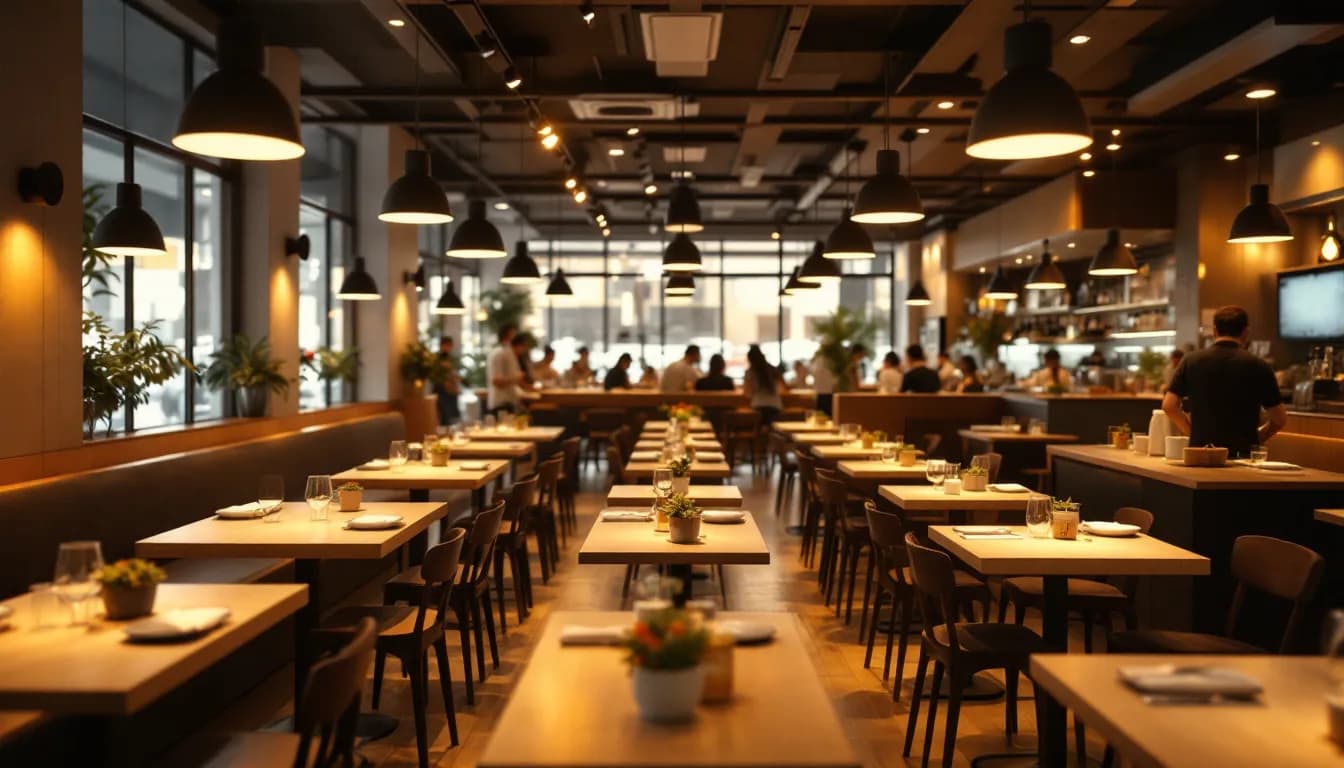
- —Inconsistent in-venue music actively undermines the brand experience guests expect at every location in a chain or franchise network.
- —Multi location music management requires business-licensed streaming, zone-level scheduling, day-parting, and real-time network-wide deployment — capabilities consumer platforms do not offer.
- —MUSICDJ Backstage lets a single operator author, schedule, and deploy playlists across all sites simultaneously, with a permission model that grants bounded local control to franchisees.
- —MUSICDJ's business licence covers the music content for commercial use; each venue remains independently responsible for its own local public-performance (PRO/PPL) fee.
- —A phased migration — audit, brand brief, library build, cohort onboarding, governance model — reduces disruption when moving an established network off ad-hoc arrangements.
- —Centralised audio management is a brand enablement tool for franchisees, not a control mechanism: it ensures every location sounds on-brand without adding to local management workload.
The Hidden Brand Risk Chains Accept When Music Is Left Unmanaged
The most consistent brand in your market can lose credibility in under three minutes — the time it takes a regular guest to notice that the music at your newest location sounds nothing like the one they visit every week.
Chains and franchises invest carefully in visual consistency: uniform signage, standardised menus, staff dress codes, and precisely specified interiors. Audio atmosphere receives a fraction of that attention, despite research in retail and hospitality atmospherics consistently finding that sound shapes a guest's mood, pace, and overall impression of a space as powerfully as anything they see.
The failure modes are familiar to any regional manager who has walked into a franchisee location unannounced:
- A manager playing personal playlists through a Bluetooth speaker
- A location defaulting to a local radio station, complete with competitor advertising and presenter talk breaks
- Volume levels set by whoever arrived first that morning
- A seasonal audio campaign that reached flagship sites but never made it to the satellite network
None of these incidents appears on an incident report. But the guest who has a polished experience at the company flagship and a jarring one at a franchise location does not distinguish between the two. They revise their opinion of the brand.
Multi location music management is the operational discipline that closes this gap. This article is a practical guide for operations directors, franchise managers, and regional leads who want to govern audio across a network with the same rigour they apply to every other dimension of the guest experience.
What Multi-Location Music Management Actually Requires
Multi location music management is not a matter of sharing a playlist link. It is the ability to author, schedule, deploy, and audit background music programmes across every site in a network from a single point of control, while retaining the option to delegate bounded local adjustments where appropriate.
Consumer platforms — however well-curated — are built for personal use. They offer no zone-level granularity, no time-of-day scheduling, no real-time network-wide override capability, and no commercial licensing for public performance in a business environment.
A serious multi-site background music system must satisfy four requirements:
- Centralised playlist authoring and brand library governance — the ability to define what the brand sounds like and make that definition the starting point for every location.
- Per-site and per-zone scheduling with day-parting — so the music at each location follows a programme appropriate to the time of day and the area of the venue, without local staff having to manage it.
- Real-time deployment and override capability — so a network-wide update or emergency change reaches every site in seconds, not over the course of a week.
- Business-licensed streaming — with the clear understanding that venues remain responsible for their own local public-performance licence fees, addressed in detail below.
MUSICDJ's background music for businesses is built around these requirements, governed through a single web dashboard — Backstage — that gives multi-site operators full visibility and control across their entire network.
How Inconsistent Audio Erodes Brand Equity — and Why It Is Difficult to See
Research in retail and hospitality atmospherics consistently points in the same direction: music tempo, genre, and volume influence dwell time, perceived quality of service, and purchasing behaviour. This makes the audio environment a commercial lever, not a decorative afterthought.
What makes audio-driven brand erosion particularly difficult to diagnose is that it rarely generates a direct complaint. A guest will report a dirty table or a wrong order. They will not raise a hand to say the playlist does not reflect the brand's identity — yet that misalignment shapes their holistic impression in ways they may not consciously articulate when deciding whether to return.
Consider a realistic franchise scenario. A casual dining chain curates an upbeat, contemporary lunchtime programme for its company-owned flagship locations. Three franchisees, left to their own devices, are playing slow ballads, a talk-radio station, and silence respectively. Every guest who visits more than one location receives a different emotional signal about what the brand stands for.
The same dynamic applies, with additional dimensions, to accommodation brands: in-room audio atmosphere is as much a part of the brand promise as lobby and common-area music. The focus of this article is background music for multi-site hospitality and retail, but the principle is identical wherever guests form expectations across a network of properties.
The solution is not policing — it is enablement. When background music brand consistency is managed centrally, every location benefits from the same curation expertise the flagship enjoys, without requiring local managers to develop skills they were never hired for.
Centralized Control Through a Single Dashboard: How Backstage Works for Multi-Site Operators
The Backstage dashboard is the operational nerve centre for multi-location audio management. All sites, all zones, and all schedules are visible and editable from a single web interface, accessible from any browser without specialist software.
The site hierarchy works as follows: the operator builds a master brand library of approved playlists and schedules under the central account. Individual sites are added as nodes beneath that account. Each site can contain multiple independently scheduled zones — dining room, bar, terrace, lobby, retail floor — each following its own programme within the overarching brand framework.
The permission model is designed with franchise networks in mind:
- A corporate operations manager can lock brand-mandatory playlists at the network level
- Local managers can be granted the ability to adjust volume, skip tracks within an approved library, or activate pre-approved alternative playlists for local events
- No local action can override the master schedule without authorisation from the account holder
The practical workflow for a seasonal rollout is straightforward: the franchisor authors new playlists centrally, publishes them to all locations simultaneously, and every site goes live without any action required from individual franchisees. No email cascade. No training call. No compliance audit to determine who actually made the update.
Players run on Android and Windows devices; remote control is available from iOS, Android, and web apps, integrating with existing hardware rather than requiring a complete device replacement programme. Operators who also use digital signage for venue screens manage both from the same Backstage account, keeping promotional campaigns coherent across sound and sight simultaneously.
Per-Zone Scheduling and Day-Parting: Local Precision at Network Scale
Day-parting is the deliberate programming of different music moods or energy levels to different times of day to match the rhythm of guest behaviour. A breakfast service benefits from quieter, conversational background music. A Friday evening trade calls for something more energetic. Venue music scheduling software that cannot accommodate this distinction is limited as a brand tool.
MUSICDJ's scheduler allows day-parting logic to be authored once at the network level and applied uniformly across all sites, or customised per site within brand-approved parameters.
A practical example: a café chain with dozens of locations programmes its dining zone to transition from soft acoustic in the morning to contemporary pop at midday to lounge beats in the evening, while the counter area maintains a brisk tempo throughout service. That logic lives in one schedule template and propagates to every location automatically.
For national or international networks, schedules apply relative to each site's local time, so a dinner-service transition fires at the correct local hour regardless of geography — a single template can serve the full estate without manual adjustment per location.
Operators can complement programmed playlists with AI jingles for branded audio moments — short idents that reinforce campaign messaging without requiring an external production agency — or use the web radio option within the same scheduling framework for a curated live-feel stream.
Licensing Realities for Chains and Franchises: What 'Business-Licensed Music' Does and Does Not Cover
This section deserves direct treatment, because misunderstanding the licensing split creates compliance exposure for chains and franchises.
What MUSICDJ's business licence covers: the music content itself is cleared for in-venue commercial streaming. Operators are not using a consumer platform in a public space — they are using a service built and licensed for business use.
What it does not cover: the venue's obligation to hold a public-performance licence from its local collecting society. That obligation remains with the venue operator and is entirely separate from the MUSICDJ subscription. Relevant bodies by territory include:
- SOKOJ in Serbia; GEMA in Germany; SACEM in France
- PRS for Music and PPL in the United Kingdom
- SIAE in Italy; SGAE in Spain; ZAMP across the Balkans
- The equivalent collecting society in every other operating territory
For franchise directors, the implication is direct: each franchisee location must independently hold the appropriate local performance licence. This obligation should be stated explicitly in the franchise agreement and the operations manual. The franchisor's music management platform does not substitute for it.
The honest reframing: because MUSICDJ handles the content-licensing layer, operators know the music itself is commercially cleared for business use. The remaining obligation — the local PRO fee — is a well-understood, administrable cost that venues already carry for any live or broadcast music. Exercise caution with any platform that claims to eliminate all licensing obligations entirely; in most territories, that framing is misleading and exposes operators to meaningful compliance risk.
Operational Efficiency: What Central Music Management Saves Across a Network
The aggregate operational burden of unmanaged audio across a large network is rarely calculated, but it is real. When each of 50 or 100 location managers independently sources, curates, and updates their own music setup, the cumulative time cost is significant — and the output is inconsistent by definition.
Centralised authoring changes this arithmetic. A single playlist or schedule change made by one person in Backstage propagates to every site immediately, replacing a cascade of emails, training documentation, and site-visit audits with a single publish action.
Campaign deployment is where the advantage is most visible. When a chain launches a seasonal promotion, the audio environment is part of the atmosphere that reinforces the campaign message. Central scheduling means the promotional audio experience activates on opening day at every location — not gradually, as individual managers work through their inboxes.
The audit capability matters equally. Backstage provides real-time visibility into what is playing at each site at any given moment, supporting franchise compliance reviews and helping operations teams diagnose brand-experience issues surfaced in guest feedback or mystery-shopper reports.
For an overview of AI tools that support branded audio creation — including jingle generation — see the AI features page. To compare account tiers for multi-site deployments, review the available pricing plans.
Migrating from a Fragmented Setup: A Practical Path for Existing Networks
Most established chains are not starting from a blank slate. The typical baseline is a patchwork of personal streaming accounts, local radio, consumer Bluetooth speakers, and ad-hoc arrangements accumulated over years of incremental growth. Acknowledging this is the starting point for a realistic migration plan.
A phased approach reduces disruption:
- Audit current state — catalogue what each site is playing, on what hardware, and who manages it today.
- Define the brand audio brief — genre ranges, tempo guidance, mood by day-part, content restrictions (explicit content, competitor advertising, talk radio), and any market-specific considerations.
- Build the master library in Backstage — create playlists and schedule templates that embody the brief before any site goes live.
- Onboard sites in cohorts — begin with company-owned locations, where change management is simpler, before extending to the franchisee network.
- Establish the governance model — define explicitly what local managers can and cannot adjust, and document it in the operations manual.
On hardware: MUSICDJ players run on Android and Windows, so existing compatible devices can often be repurposed, reducing the capital outlay for a network rollout.
For franchisee adoption, framing matters. Central music management removes a task that franchisees were never resourced to do well, ensures their location always sounds on-brand, and means they receive promotional updates automatically rather than chasing corporate communications. Positioned correctly, it is a service the franchisor provides, not a constraint imposed.
For large networks, a regional pilot — one area on Backstage for a defined period — generates the operational evidence and franchisee feedback needed to build the internal business case for a full rollout.
Conclusion: Brand Consistency Is a System, Not a Playlist
In a chain or franchise, the guest experience is only as consistent as the systems that govern it. Music left to local discretion is music left to chance — and the cumulative effect of that chance across dozens or hundreds of locations is a brand that sounds different depending on which door a guest happens to walk through.
The solution architecture is straightforward: Backstage as the single point of control; per-zone, per-site scheduling with day-parting authored once and deployed everywhere; a clear licensing split that keeps operators informed and compliant; and AI tools that extend creative capability without adding production overhead.
Operators who centralise their audio management gain a brand consistency lever that costs relatively little to operate but delivers guest-experience returns across every site in the network.
Explore MUSICDJ's background music for businesses in detail, or start a trial at /get-started. Contact the team directly to discuss network pricing and deployment support for chains and franchises of any size.
Consumer Streaming vs. a Dedicated Business Music Platform
| Feature | Consumer Streaming | MUSICDJ Background Music |
|---|---|---|
| Commercial licence for business use | Not included | Included in subscription |
| Zone-level, per-site scheduling | Not available | Per-zone day-parting across all sites |
| Network-wide playlist deployment | Manual, per account | Single publish to every location |
| Permission and delegation model | Not available | Corporate lock with delegated local control |
| Ad breaks and presenter interruptions | Present on free or radio tiers | None |
| Real-time override from a central dashboard | Not available | Available via Backstage on any browser |
| AI jingles and branded audio content | Not available | Built-in via MUSICDJ AI |
Frequently asked questions
Does a MUSICDJ subscription cover all licensing obligations for my franchise network?
No — and any platform that claims otherwise should be treated with caution. MUSICDJ Background Music is licensed for commercial business use, meaning the music content itself is cleared for in-venue streaming. However, each venue location remains independently responsible for holding a public-performance licence from its local collecting society — such as PRS and PPL in the UK, GEMA in Germany, SACEM in France, SOKOJ in Serbia, or the equivalent body in your territory. This obligation sits with the venue operator and is not removed by the MUSICDJ subscription. Franchise directors should address this requirement explicitly in their franchise agreements and operations manuals.
Can individual franchisees or local managers still adjust the music at their location?
Yes, within boundaries the franchisor defines. Backstage's permission model allows a corporate operations manager to lock brand-mandatory playlists at the network level while granting local managers the ability to adjust volume, skip tracks within the approved library, or activate pre-approved alternative playlists for local events. Local managers cannot override the master schedule without authorisation from the account holder.
What hardware is required to run MUSICDJ across a multi-site network?
MUSICDJ players run on Android and Windows devices, and the Backstage management dashboard is accessible from any web browser. Remote control is available from iOS, Android, and web apps. This means existing compatible devices at each site can often be repurposed, reducing the capital outlay for a network rollout.
How does day-parting work when sites are in different time zones?
Schedules in Backstage are applied relative to each site's local time. A dinner-service playlist transition triggers at the correct local hour regardless of where the site is located, so a single schedule template can serve a national or international network without manual per-location adjustment.
Can I manage background music and digital signage from the same account?
Yes. Operators who use both MUSICDJ Background Music and MUSICDJ Digital Signage manage both from the same Backstage dashboard, keeping promotional campaigns coherent across audio and visual content simultaneously.
Bring Your Entire Network In Tune
MUSICDJ Background Music gives multi-site operators a single dashboard for authoring, scheduling, and deploying brand-consistent audio across every location — with the flexibility to delegate bounded local control where it makes sense. Explore the product in detail or start a trial today.
Explore Background Music