AI for Restaurants: Practical Uses That Actually Help in 2026
A no-hype, operator-level breakdown of where AI genuinely earns its place in a restaurant today — from atmosphere and signage to guest interaction — and where it still falls short.
- —AI earns its place in restaurants where it removes repetitive manual work or fills a skill gap — not where it tries to replace hospitality judgment or staff relationships.
- —The highest-return, lowest-friction AI applications available today are atmosphere management (music scheduling, AI jingles) and content creation (digital signage visuals, menu formatting).
- —MUSICDJ music is licensed for business use, but venues remain responsible for their own local public-performance or PRO fees — AI scheduling does not change or remove that obligation.
- —AI guest agents are well-suited to accommodation settings with high inbound query volume; for restaurant operators, the more relevant guest-facing tools are QR digital menus and smart review prompts.
- —AI tools that require significant data input, integration work, or model training before delivering value are not yet practical for most independent restaurants.
- —Start with one high-friction use case, measure the result over 60 to 90 days, and expand from evidence — not from vendor enthusiasm.
What AI Actually Means for a Restaurant Operator in 2026
The phrase 'AI for restaurants' covers an enormous range of claims — from kitchen robots to predictive ordering systems to tools that generate a daily specials board in thirty seconds. Before evaluating any of it, it helps to strip the concept back to what AI actually does in operational practice: it recognises patterns in data, generates content from those patterns, and automates decisions that would otherwise require a human to repeat the same task manually.
That definition is deliberately narrow, and deliberately useful. It separates the AI that is already embedded in tools operators use today — music scheduling, menu content generation, signage visuals — from the standalone AI platforms that promise transformation but require months of integration work, clean historical data, and dedicated technical resource before they deliver anything.
The honest frame for this article is this: AI earns its place in a restaurant where it removes a repetitive manual task or fills a genuine skill gap that the team does not have. It does not replace hospitality instinct, the judgment of an experienced floor manager, or the human relationships that define a restaurant's culture. Operators who approach AI with that clarity tend to get real value from it. Operators who approach it as a general-purpose solution tend to waste time and budget.
In 2026, there are three zones where AI has genuine, demonstrable traction in restaurant and hospitality operations:
- Atmosphere management — music scheduling, day-parting, and branded audio content
- Content creation — digital signage visuals, menu formatting, and promotional material
- Guest-facing communication — digital menus, review prompts, and (in accommodation contexts) AI guest agents
There are also areas where AI consistently underdelivers for independent operators: complex order management, full POS automation, nuanced complaint resolution, and hyper-personalisation at scale. Those limitations are covered honestly later in this article, because understanding them is as operationally useful as understanding what works.
AI-Driven Background Music: Atmosphere on Autopilot
The operational problem is one most restaurant operators recognise immediately. Manually curating playlists for breakfast service, the lunch rush, early evening dining, and late-night bar trade is time-consuming, requires a degree of musical knowledge and brand awareness, and — in practice — is often neglected. The result is mismatched atmosphere: a high-energy playlist bleeding into a quiet Sunday brunch, or a lounge set running through a busy Friday dinner service because nobody updated the queue.
AI-assisted music management solves this at the scheduling layer. Operators define the rules once — energy level, genre direction, tempo range, and time blocks — and the system executes without daily intervention. The background music for restaurants platform from MUSICDJ handles day-parting and scheduling across zones from a single dashboard, which means the bar, the dining room, and the terrace can each run differentiated atmospheres without anyone manually managing three separate queues.
The more distinctive capability is AI jingle generation. Rather than commissioning a studio every time a seasonal campaign or promotional message needs a branded audio ident, MUSICDJ's real-time AI jingles produce that content on demand. For a restaurant running a summer menu push or a weekend brunch promotion, this removes a genuine production bottleneck. If you want to explore what AI jingles for your venue look like in practice, the AI section of the platform covers this directly.
The licensing reality — stated plainly
MUSICDJ music is licensed for business use. That covers the streaming and scheduling of music within your venue through the platform. It does not cover your venue's local public-performance obligation. Depending on your territory, you will still need to hold and pay for your own licence from the relevant collecting society — SOKOJ, GEMA, SACEM, PRS for Music, SIAE, SGAE, ZAMP, or the equivalent body in your market. AI scheduling does not change, reduce, or remove that obligation. Budget for both independently, and verify your local requirements directly with the relevant PRO rather than relying on any platform's representation of what is covered.
Where AI music management delivers most
The value is highest in multi-zone venues. A single-room café with one speaker system and a consistent clientele can manage atmosphere manually without much friction. A venue with a separate bar, a dining room, a private events space, and a terrace — each requiring a different energy level across different service periods — faces a coordination problem that manual playlist management handles poorly. That is where AI scheduling genuinely earns its place.
AI-Generated Digital Signage: Menus and Promotions Without a Design Team
Most independent restaurants and small groups do not have an in-house designer. That is not a criticism — it is a structural reality of how hospitality businesses are staffed. The consequence is that seasonal menu boards, daily specials, and promotional visuals either look inconsistent, lag behind the actual menu, or never get updated at all because updating them requires skills the team does not have and budget the operation cannot justify for routine changes.
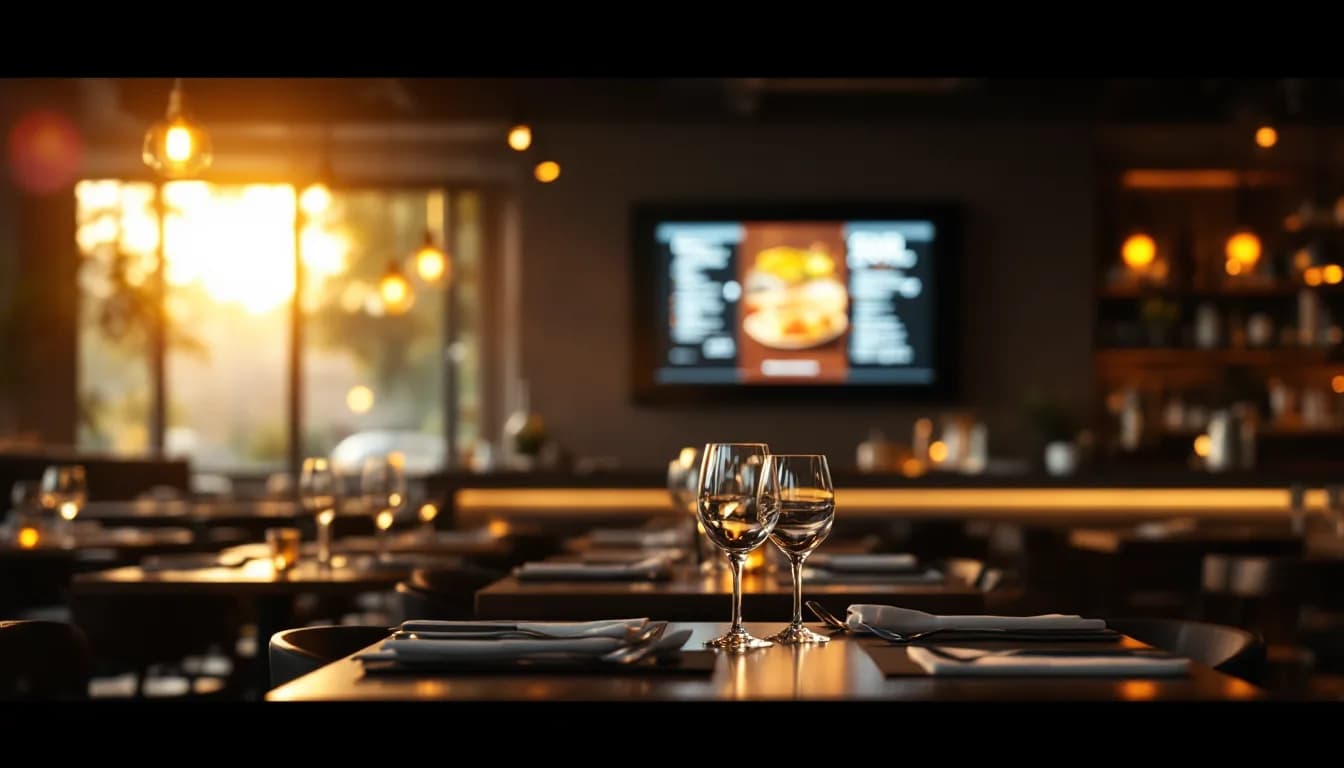
Digital signage for restaurants with an AI generation layer addresses this directly. Within the MUSICDJ platform, operators can produce on-brand promotional and menu visuals without external design software or agency involvement. The AI assists in generating visuals from within the platform — not as a replacement for brand identity, but as a workhorse for the routine content that needs to exist and be current.
AI menu generation extends this into content structure: the system can assist in formatting and organising menu content for display, which reduces the manual reformatting work that accumulates every time a dish changes, a price is updated, or a seasonal item rotates on and off the board.
Scheduling per zone
Signage content can be scheduled to match service periods without manual intervention. Lunch specials appear at midday. Cocktail and wine promotions surface in the early evening. Brunch imagery runs on weekend mornings. The operator sets the schedule once; the system executes it. This is the same principle as music day-parting applied to visual content — and it delivers the same benefit: consistent, appropriate messaging without daily manual management.
Where AI signage has limits
AI-generated visuals are a strong starting point and cover most everyday operational needs. They are not a substitute for a considered brand campaign with specific photography, custom illustration, or the kind of creative direction that defines a restaurant's visual identity in a competitive market. The practical advice is to treat AI signage as the workhorse for routine updates — daily specials, price changes, seasonal rotations — and reserve design budget for the hero brand moments that genuinely require human creative direction.
AI Guest Agents: The Right Context Matters
Conversational AI agents that handle routine inbound questions — opening hours, menu information, allergen basics, directions, reservation queries — represent a genuinely useful application of the technology. The operational logic is straightforward: a high volume of repetitive inbound messages consumes staff time and often lands on the owner's personal phone at inconvenient hours. An AI agent that handles the routine tier of that volume, and escalates to a human when a query requires judgment, protects both response quality and personal time.
It is important to be specific about where this application is currently most effective. MUSICDJ's AI guest agent is a feature of the STAY product — built for small hotels, guesthouses, apartments, and Airbnb rentals, where the inbound query volume from guests across different time zones and booking platforms creates a genuine around-the-clock communication burden. In that context, the agent operates 24/7 and hands off to the owner's WhatsApp when a query requires a human decision. The handoff model is the point: the AI filters and triages, so the owner only engages when genuinely needed.
For restaurant operators specifically, the guest agent in its current form is not a direct fit — it is designed for accommodation contexts, not for table service environments. Restaurant operators evaluating conversational AI for their own guest communication should assess tools built for that specific use case, with clear escalation paths and defined scope, rather than adapting accommodation-focused products.
What honest AI agent deployment looks like
Regardless of context, the principles for responsible AI agent deployment are consistent:
- Define explicitly what the agent is authorised to answer and what it must escalate
- Ensure there is no scenario where a guest is left in a loop with an AI that cannot resolve their issue
- Review agent transcripts regularly to catch gaps, errors, or tone problems
- Never deploy AI in complaint-handling workflows without a clear and fast human escalation path
AI cannot read the room. It cannot judge when a guest needs a comped dessert versus a sincere conversation. It cannot repair a relationship the way an experienced floor manager can. Any deployment that tries to automate those moments without human oversight creates more problems than it solves.
CONNECT and PayPlay: Reducing Friction at the Table
The CONNECT digital menu and guest app is a QR-based system that gives guests access to the menu, Google review prompts, and now-playing information from their own device — with no download required. From an operator perspective, it removes a category of routine staff workload: guests who want to know what is on the menu, what a dish contains, or what song is playing can find out without flagging down a server.
AI menu generation assists in keeping the digital menu current. The system can help draft, structure, or reformat menu content, which reduces the time cost of updating the digital menu every time a dish changes or a seasonal item rotates. A digital menu that is always accurate is significantly more useful than one that is occasionally out of date — and the AI layer reduces the friction that causes operators to let updates slip.
PayPlay: guest participation in the atmosphere
The PayPlay guest song jukebox is a paid guest music request feature within CONNECT. Guests can influence the music playing in the venue within parameters the operator sets — genre, tempo, acceptable tracks — which creates genuine engagement without requiring any operator effort during service. It is not AI in the generative sense, but it represents a form of intelligent guest participation: the venue atmosphere becomes something guests interact with rather than simply receive.
Review prompts and smart timing
Surfacing a Google review prompt at the right moment in the guest journey — post-meal, when satisfaction is likely high — is a low-effort, high-return application of smart timing. CONNECT enables this without requiring staff to remember to prompt guests manually. The operational value is real: consistent review generation is one of the more measurable outcomes a restaurant can drive through guest-facing technology, and removing the human dependency from the prompt increases consistency.
The honest framing for CONNECT is that its primary value is removing friction — for the guest navigating the menu and for the operator managing routine information requests. The AI layer enhances content creation and timing; it does not automate the hospitality itself.
Where AI Still Falls Short in Restaurants: An Honest Assessment
The areas where AI underdelivers are worth understanding in detail, because vendor marketing in this space tends to compress the gap between what is technically possible and what is operationally practical for an independent restaurant.
Kitchen operations and order management. AI tools marketed for kitchen optimisation and predictive ordering remain inconsistent in real-world independent restaurant conditions. Data quality, integration complexity, and the genuine variability of hospitality demand — events, weather, last-minute large parties — make these harder to deploy reliably than vendors often suggest. The operators who get value from predictive tools tend to be larger groups with clean, multi-year historical data and dedicated operations teams.
Staff scheduling. AI scheduling tools exist and work well in stable, data-rich environments. Restaurants with high seasonality, irregular events, or small teams often find that the setup cost and data preparation required outweigh the benefit at this stage of the technology's development.
Complex complaint resolution. This is the area where the gap between AI capability and hospitality reality is most pronounced. An AI cannot assess the emotional state of a guest, cannot improvise a recovery that fits the specific situation, and cannot make the kind of discretionary judgment — a comped dish, a personal apology from the manager, a follow-up call — that turns a negative experience into a loyal guest. Deploying AI in complaint workflows without a fast, clear human escalation path is a risk that most independent operators should not take.
Personalisation at scale. The promise of AI remembering individual guest preferences and delivering hyper-personalised experiences is real — in large chain environments with robust CRM infrastructure, loyalty programme data, and dedicated technology teams. For independent operators, the data infrastructure required to make this work is not yet practical. Building it from scratch carries a cost and complexity that the personalisation benefit does not currently justify for most.
The general lesson across all of these areas is consistent: AI tools that require significant data input, integration work, or ongoing model training before they deliver value are not yet practical for most independent restaurants. The tools that work today are those embedded in platforms operators already use for other reasons — where the AI layer adds capability without adding a separate implementation project.
How to Evaluate Any AI Tool Before Committing
The evaluation process matters as much as the tool itself. A few questions that separate genuinely useful AI products from well-marketed ones:
Ask for a real-environment demonstration. Request to see the feature working in an actual restaurant or hospitality setting, not a curated demo with ideal inputs. Specifically ask what happens when the AI encounters an edge case or an input it was not trained on — the answer reveals how robust the system actually is.
Assess the true setup cost. How much staff time, data preparation, or integration work is required before the tool delivers value? Tools that require months of configuration before producing results carry a real opportunity cost, particularly in an industry where management bandwidth is already stretched.
Understand the escalation path. For any AI that interacts with guests, confirm exactly how and when a human takes over. There should be no scenario where a guest is left in an unresolved loop. If the vendor cannot clearly describe the escalation mechanism, that is a meaningful signal.
Check licensing and compliance implications independently. For music-related AI tools specifically, confirm what the platform's business licence covers and verify your local PRO obligations directly with the relevant collecting society. Do not rely solely on the vendor's representation of what is and is not covered.
Start with one use case. Operators who try to deploy AI across multiple functions simultaneously rarely succeed. Identify the single highest-friction task in your current operation — the thing that consumes the most repetitive manual time or creates the most inconsistency — and test AI against that specific problem before expanding.
Building an AI-Ready Restaurant Operation: A Practical Roadmap
For operators who have decided to move forward, a phased approach consistently outperforms a broad simultaneous rollout.
Phase 1 — Atmosphere and content (lowest friction, highest immediate return)
Deploy AI-assisted background music scheduling and digital signage generation first. These require minimal data, integrate with existing screens and speaker systems, and deliver visible results within days. The operational lift is low; the impact on guest experience is immediate. This phase also builds the team's confidence with AI tools before moving to more complex applications.
Phase 2 — Guest communication
Introduce a QR digital menu with AI-assisted content generation. If your venue has high inbound query volume — particularly if you also operate accommodation — evaluate whether an AI guest agent with a defined scope and clear human handoff is appropriate for that context. For restaurant-only operations, the focus at this phase is the digital menu, review prompts, and PayPlay engagement.
Phase 3 — Review and expand
After 60 to 90 days, assess which AI tools have demonstrably reduced staff workload, improved guest experience, or contributed to revenue — through PayPlay engagement, review volume growth, or signage-driven upsells. Use that evidence to decide whether to expand AI use or consolidate what is working. Evidence-based expansion is significantly more reliable than enthusiasm-based expansion.
Ongoing discipline
Assign one person on the team to own AI tool performance. This means reviewing signage accuracy, monitoring music scheduling for drift, and — where applicable — checking agent transcripts for gaps or errors. AI tools that run without oversight tend to drift from the operator's intent over time. The oversight role does not require technical expertise; it requires someone who knows the venue well enough to notice when the output stops matching the standard.
The cultural point
AI works best in restaurants where the team understands what it is doing and why. Brief staff on what each AI tool handles and what it does not. If guests ask why the music changes at a certain time, or how the digital menu is updated, staff should have a confident, honest answer. That transparency reinforces rather than undermines the guest experience — and it prevents the awkward situation where a guest knows more about the technology in the room than the people working in it.
For operators ready to start, get started with MUSICDJ covers the platform's full range of tools and how they fit together across a restaurant or hospitality operation.
AI-Embedded Platform Tools vs. Standalone AI Platforms: What Operators Should Weigh
| Dimension | AI embedded in existing platform (e.g. MUSICDJ) | Standalone AI platform |
|---|---|---|
| Setup time before value is delivered | Days — integrates with existing screens, speakers, and dashboard | Weeks to months — typically requires data preparation, API integration, or dedicated onboarding |
| Data requirements | Low — works from operator-defined rules and schedules | High — often requires clean historical data before the model performs reliably |
| Staff training required | Minimal — managed from a single dashboard operators already use | Moderate to significant — new interface, new workflows, new failure modes to learn |
| Licensing and compliance clarity | Business-use music licence included; PRO/PPL obligation remains with the venue | Varies by vendor; always verify independently with your local collecting society |
| Practical fit for independent restaurants | High — designed for venues without dedicated tech or design teams | Variable — often optimised for larger groups or chains with technical resource |
| Escalation path for guest-facing AI | Defined handoff to owner or staff (as in STAY product for accommodation) | Varies widely; must be confirmed before deployment |
| Cost of failure if the tool underperforms | Low — atmosphere and signage issues are visible and correctable quickly | Higher — integration investment and staff time already spent before the gap is apparent |
Pyetjet e shpeshta
Does using MUSICDJ mean my restaurant does not need a separate music licence?
No. MUSICDJ provides a business-use music licence that covers the streaming and scheduling of music through the platform. Your venue still has its own separate obligation to hold a public-performance or PRO licence from the relevant collecting society in your territory — SOKOJ, GEMA, SACEM, PRS for Music, SIAE, SGAE, ZAMP, or the equivalent body in your market. These are two distinct obligations. Verify your local requirements directly with the relevant PRO.
What is the difference between AI jingles and standard background music scheduling?
Standard background music scheduling uses day-parting and scheduler rules to play the right genre, tempo, and energy level at the right time — without daily manual intervention. AI jingles are a separate capability: they generate branded audio idents or transitional audio on demand, which means you can produce a seasonal promotional audio message or a branded sound without commissioning a studio. Both features are available within the MUSICDJ platform.
Is MUSICDJ's AI guest agent suitable for restaurant operators?
The AI guest agent is a feature of MUSICDJ's STAY product, which is built specifically for small hotels, guesthouses, apartments, and Airbnb rentals. It is designed for accommodation contexts where guests send inbound queries across different time zones and booking platforms. For restaurant-only operators, the more relevant guest-facing tools are CONNECT (the QR digital menu and guest app) and PayPlay (the guest song jukebox), both of which reduce routine staff workload and improve the table-level guest experience.
How quickly can a restaurant see results from AI-assisted digital signage?
For most venues, results are visible within days of deployment. AI-generated signage visuals and scheduled content updates do not require data preparation or model training — operators define the content and schedule, and the system executes. The most immediate impact is typically on consistency: daily specials, price changes, and promotional content appear on screens when they should, without manual intervention.
What should a restaurant operator do before committing to any AI tool?
Ask to see the feature demonstrated in a real operational environment rather than a curated demo. Assess the true setup cost in staff time and data preparation. Confirm the escalation path for any AI that interacts with guests. Verify licensing and compliance implications independently with the relevant authority. And start with one high-friction use case rather than attempting a broad rollout — measure the result over 60 to 90 days before expanding.
Can PayPlay disrupt the atmosphere the operator has set?
PayPlay is designed to operate within parameters the operator defines. Guests can request songs within the genre, tempo, and content boundaries the operator has set — they influence the atmosphere rather than override it. The operator retains control of the guardrails; guest participation happens within those constraints.
See Which AI Tools Fit Your Restaurant Operation
MUSICDJ brings background music scheduling, AI jingles, digital signage generation, and guest-facing digital menus into one platform — built for hospitality venues without dedicated design or technology teams. No hype, no complex integration. Start with the use case that matters most to your operation.
Get Started with MUSICDJ