
Digital Transformation for Small Restaurants: A Practical Roadmap
A phased, budget-conscious roadmap showing independent restaurant, café, and bar operators exactly which digital layers to add first — atmosphere, guest-facing, then operational — and why incremental adoption beats a costly all-at-once overhaul.
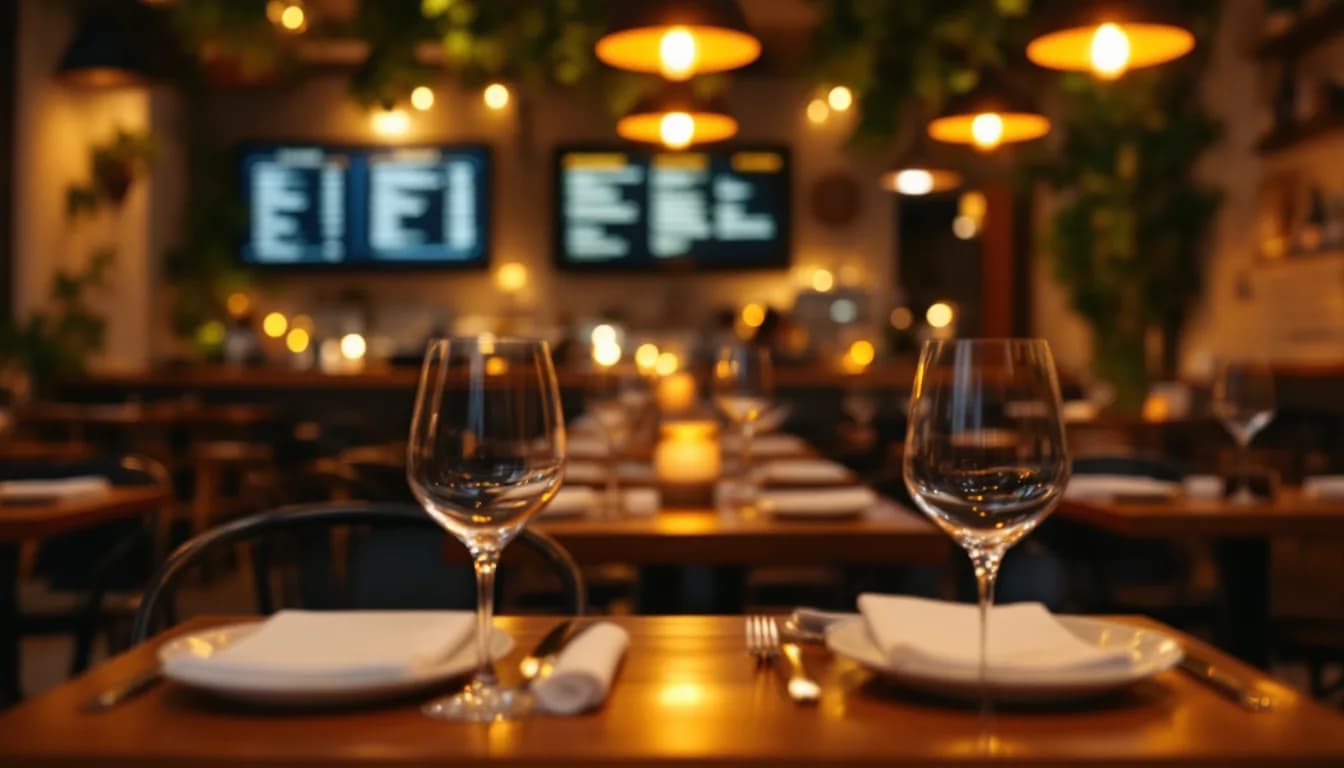
- —Restaurant digital transformation works best as a staged process — atmosphere first, then guest-facing tools, then operational automation — rather than a simultaneous overhaul.
- —Atmosphere technology (background music, digital signage) delivers always-on value with minimal staff involvement and is the right first investment for most small operators.
- —A no-download QR guest web app removes the single biggest adoption barrier for guest-facing tools: app-store friction.
- —A business music streaming licence covers the sound recording rights on the platform but does not replace the venue's separate public-performance licence obligation to its national PRO.
- —One consolidated dashboard managing music, signage, and guest-facing tools eliminates the integration overhead that operators without dedicated IT staff cannot afford.
- —Phased adoption allows course-correction: if a feature does not suit your concept — a guest jukebox in a fine-dining room, for example — you can defer it before committing the next layer of investment.
- —Accommodation operators running an on-site restaurant should complete the atmosphere phase across both spaces before activating in-room guest technology, so the experience is consistent throughout the property.
Why Small Restaurants Need a Roadmap, Not a Revolution
Restaurant digital transformation is not about replacing your team with tablets or rebuilding your business around software. In plain terms, it is the deliberate, staged adoption of technology that improves the guest experience, reduces manual work, and creates new revenue touchpoints — without disrupting the daily operations your regulars already rely on.
That distinction matters, because the conversation around hospitality technology is too often dominated by enterprise-scale thinking: full POS migrations, ERP rollouts, centralised data warehouses. Those projects make sense for a fifty-location chain with a dedicated IT department. They make very little sense for an independent restaurant operator managing the floor, the kitchen, the rota, and the accounts from the same desk.
What independent operators do share with their larger competitors is the pressure of guest expectation. Diners now move fluidly between polished chain restaurants, boutique neighbourhood concepts, and everything in between. They notice when the music is jarring or absent. They notice when the menu is a laminated card that does not match what the server is describing. They notice when a screen is showing a promotion from three months ago. The comparison is constant, even if it is never spoken.
The framework this guide uses to navigate that pressure is what we call the AGO model: three layers of technology adoption, sequenced by the return they deliver and the readiness they require.
- Atmosphere — what guests feel the moment they walk in: music, visuals, ambient brand signals.
- Guest-Facing — what guests interact with directly: digital menus, review prompts, music requests.
- Operational — what the management team controls: automation, AI-assisted content, unified scheduling.
Sequencing matters because each layer compounds the one before it. Atmosphere improvements are always-on and require almost no staff involvement after setup — making them the right first investment. Guest-facing tools build on a strong atmosphere to deepen engagement and generate loyalty signals. Operational tools then reduce the management overhead that Phases 1 and 2 introduce, letting automation handle the repetitive work.
The honest expectation to set at the outset: this is not a one-time project. Restaurant digital transformation is an ongoing process. Small wins compounding over six to eighteen months will always outperform a costly big-bang launch that overwhelms staff, drains cash reserves, and leaves half the features unused because no one had time to learn them.
The Budget Case for Incremental Adoption
The financial argument for phased adoption is straightforward. When upfront hardware costs, software subscriptions, staff training time, and integration troubleshooting all arrive in the same month, the cash-flow compression happens at precisely the moment of maximum uncertainty — before any of the tools have had time to prove their value.
The compounding logic of phased adoption works in the opposite direction. Atmosphere improvements can lift average spend and extend dwell time; those gains offset the cost of guest-facing tools, which in turn generate review volume and repeat visits that justify investing in operational automation. Each layer funds the next, rather than all layers competing for the same budget line simultaneously.
There is also a structural advantage to how modern hospitality technology is priced. Most purpose-built tools are subscription or per-device licence models, which converts a large capital expenditure risk into manageable operating expenditure. The financial exposure at any given phase is bounded.
Staff readiness is the hidden cost that budget calculations rarely capture. Introducing one digital layer at a time gives front-of-house and kitchen teams space to adapt without role anxiety. Retraining costs and staff turnover driven by technology overwhelm are real expenses — they simply do not appear on the software invoice.
Incremental adoption also preserves the right to course-correct. If a feature does not resonate with your specific guest profile — a guest song jukebox in a quiet fine-dining room, for instance — you can pause before committing the next layer of investment. That option does not exist when everything is deployed at once.
Finally, there is a consolidation advantage that is critical for operators without dedicated IT support. Choosing a platform that integrates licensed background music for restaurants, digital signage for menus and promotions, a QR digital menu and guest web app, and AI tools for hospitality venues under one dashboard eliminates the per-tool support burden and the integration overhead that comes from stitching together unrelated products.
Phase 1 — Atmosphere: Music and Visuals That Work While You Sleep
Atmosphere technology is the right first investment for one simple reason: it is always on. Every guest who walks through the door experiences it immediately, without any interaction from staff, and without any action from the guest. The broader body of retail and hospitality atmospherics research consistently points to music and ambient environment as significant drivers of dwell time, perceived quality, and willingness to spend — not as marginal factors, but as foundational ones.
Background Music for Restaurants
A purpose-built business music platform does things a consumer streaming service cannot. Licensed background music for restaurants through MUSICDJ includes per-zone playlist management, which means the bar, the main dining room, and the terrace can each carry music that suits the energy and volume of that specific space — simultaneously, from one account.
Day-parting lets operators programme different musical energy for different periods: something more upbeat for the lunch service, a more relaxed tone for the mid-afternoon lull, something warmer and more atmospheric for the evening. The scheduler automates those transitions. No staff member needs to remember to change the playlist at 5pm.
Web radio integration gives operators a low-effort route to variety. Curated, genre-matched internet radio streams can supplement original playlists, maintaining freshness without requiring the operator to build every playlist manually.
Real-time AI jingles are a meaningful differentiator at this phase. Rather than a generic announcement interrupting the music, AI-generated branded audio moments — a happy hour cue, a daily special, an event reminder — are woven into the music stream in a way that feels on-brand rather than intrusive.
Digital Signage for Restaurants
Digital signage for menus and promotions solves a problem that every small restaurant operator knows: static printed menus are expensive to reprint, slow to update, and immediately out of date the moment a price changes or a dish sells out. A live-editable signage system pushes a price change or a daily special to every screen in seconds.
AI-generated visuals, available directly within the signage platform, allow operators to produce on-brand promotional images for daily specials, events, and seasonal offers without commissioning a designer for routine content. This capability is introduced at Phase 1 because it is native to the signage tool — operators will encounter it here first.
A Mandatory Note on Music Licensing
This point is not optional reading. MUSICDJ's background music service is licensed for business use, which covers the master recording rights streamed through the platform. That is a meaningful and necessary licence. However, it does not replace the venue's separate public-performance licence obligation.
In most territories, performing music in a public venue — regardless of which streaming service delivers it — requires a licence from the relevant national performing rights organisation: SOKOJ in Serbia, GEMA in Germany, PRS in the United Kingdom, SACEM in France, SIAE in Italy, SGAE in Spain, ZAMP in Croatia and Slovenia, or the equivalent body in your territory. These are separate legal obligations. MUSICDJ does not fulfil them on your behalf. If you are not already registered with your local PRO, do that before or alongside activating any music service.
Phase 1 Checklist
- One player device per zone, connected and configured
- Playlist or web radio stream selected and running
- Day-part schedule built and live
- At least one digital signage screen active with current content
- PRO licence confirmed as current and separate from the streaming subscription
Estimated time to operational: days, not weeks.
Phase 2 — Guest-Facing: Turning Every Table Into a Touchpoint
With the atmosphere layer running reliably, the next phase moves technology from the background into the guest's hands — without adding friction for them or workload for the team.
CONNECT: The QR Guest Web App
The QR digital menu and guest web app — MUSICDJ's CONNECT product — is the Phase 2 centrepiece. Guests scan a QR code at the table and access a web app instantly, with no download, no app store, no account creation. That no-download design is not a minor convenience; it is the critical adoption lever. Any friction at the point of scan dramatically reduces the number of guests who complete the action. Removing the app-store barrier entirely is what makes guest uptake realistic in a real-world dining environment.
Digital Menu for Restaurants
A digital menu for restaurants does more than replicate the printed version on a screen. Updates are instant — no reprint cost, no laminated inserts, no servers verbally correcting a menu that is already in a guest's hands. Allergen information and descriptions can be kept accurate in real time. For small operators running lean, the cumulative saving on menu reprints and the reduction in service errors from outdated information are both meaningful.
Google Reviews Integration
CONNECT surfaces a Google review prompt at the natural high point of the visit — after the meal, while the guest is still at the table and the experience is fresh. Presenting that prompt at the right moment, rather than relying on the guest to remember later, meaningfully increases the likelihood of a review being posted. The quality of that review is also more likely to reflect the actual experience rather than a faded recollection. This is a qualitative observation consistent with how review behaviour works; no specific uplift figure should be assumed for any individual venue.
Now-Playing
Guests can see what track is currently playing through the same web app. This is a small feature with a disproportionate effect on perceived brand sophistication. It also reinforces the atmosphere investment from Phase 1 — the music is no longer invisible; it becomes part of the conversation.
PayPlay — The Guest Jukebox
PayPlay, MUSICDJ's guest song jukebox, allows guests to pay a small fee through the web app to request a song that plays in the venue. It is an opt-in revenue stream, not a mandatory component of Phase 2, and format suitability matters. PayPlay is well-suited to bars, casual dining venues, and event-driven spaces where guest participation in the music adds to the atmosphere. It is less appropriate for fine-dining rooms or quiet cafés where the curated music programme is part of a more controlled guest experience. Decide deliberately; there is no cost to deferring it.
Phase 2 Checklist
- QR codes printed and placed on tables
- Digital menu populated, reviewed for accuracy, and tested on a real device
- Google review flow tested end-to-end from scan to submission
- PayPlay enabled or consciously deferred based on venue format
Estimated time to operational: one to two days of setup.
Phase 3 — Operational Intelligence: Letting AI Do the Repetitive Work
Phase 3 is not about adding more features for guests to see. It is about reducing the management overhead that Phases 1 and 2 have introduced — not replacing human judgement, but amplifying it by automating the work that does not require it.
AI Menu Generation
Building and maintaining a digital menu takes more time than most operators expect. AI tools for hospitality venues can accelerate the creation and editing of menu content — descriptions, categorisation, formatting — reducing the hours an operator spends on menu administration and making it easier to keep the digital menu current.
AI Signage Visuals at Scale
Building on the AI-generated visuals introduced with Digital Signage in Phase 1, operators at this stage use the same capability more systematically — producing a rolling schedule of promotional content for daily specials, events, and seasonal offers without relying on a designer for routine material. The difference between Phase 1 and Phase 3 is not the tool; it is the discipline. Phase 3 is where content creation becomes a planned, scheduled process rather than an ad hoc response.
The Backstage Dashboard
Backstage is MUSICDJ's single control point across background music, digital signage, CONNECT, and IPTV. For a small restaurant operator managing multiple responsibilities simultaneously, having one dashboard — accessible from any browser — reduces the cognitive load of managing multiple tools with separate logins, separate support contacts, and separate content libraries. The goal is that the entire digital environment can be reviewed and adjusted in a single session.
Scheduling and Automation
The scheduler ties together music day-parting, signage content rotation, and promotional triggers. A lunch special promotion can appear on screens and trigger an AI-generated audio jingle automatically at 11:45, with no staff action required. That kind of automation does not require technical expertise to configure; it requires the operator to define the rules once and then let the system run.
IPTV as an Optional Phase 3 Add-On
IPTV — live TV on venue screens, managed from a phone — is a relevant addition for sports bars, family-casual venues, and hotel breakfast rooms. It is not a universal requirement, and for many restaurant formats it will never be relevant. Present it as a considered addition based on your guest profile, not a default component of the operational layer.
Phase 3 Checklist
- Backstage dashboard configured as the single management point for all active zones
- AI content tools tested with at least one real use case: a menu item description, a promotional visual
- Scheduled automations reviewed and confirmed as running without manual triggers
- Ongoing: a monthly content audit to keep signage and playlists current and accurate
A Special Case: Restaurants Inside Small Hotels, Guesthouses, and Apartments
Many small restaurants sit inside or adjacent to accommodation — boutique hotels, guesthouses, bed-and-breakfasts, Airbnb properties — where the guest journey extends well beyond the meal. For operators in this position, the digital transformation roadmap has an additional layer.
MUSICDJ STAY is designed for small hotels, guesthouses, apartments, and Airbnb rentals. It provides an in-room guest TV experience, a branded no-download guest app, and an AI guest concierge that fields questions around the clock and escalates to the owner's WhatsApp when a human response is needed.
For accommodation operators who are also managing bookings across multiple channels, STAY includes a channel manager connecting to Booking.com, Airbnb, Expedia, Google Hotels, Vrbo, Agoda, Trip.com, HRS, and Check24, alongside direct booking capability. Managing distribution from one place reduces the double-booking risk and the administrative overhead of updating availability across platforms manually.
The STAY pricing model is worth understanding clearly: one permanent licence per room, with no monthly platform fee per room. For small properties where recurring per-room SaaS fees accumulate quickly even at modest room counts, this structure is a meaningful financial differentiator.
For operators running both accommodation and a restaurant, the sequencing recommendation is straightforward: complete the atmosphere phase across both the restaurant and the guest rooms before activating STAY's guest-facing features. Consistency of experience across the property matters; a polished dining room and an unfinished room experience creates a dissonance that undermines both.
Learn more about the accommodation layer at /stay.
Common Mistakes Small Restaurants Make During Digital Transformation
Buying hardware before defining the use case. A screen purchased without a clear content plan becomes expensive wallpaper. Always define the job-to-be-done — menu display, promotional rotation, ambient branding — before selecting the device.
Confusing activity with progress. Setting up a consumer streaming account or a generic free QR menu tool creates the appearance of transformation without the scheduling, zone management, or licensing compliance that a purpose-built hospitality platform provides. The gap between the two is not cosmetic.
Assuming a business music licence covers all obligations. This is the most common and potentially costly misconception in hospitality technology. A business music streaming licence covers the sound recording copyright on the platform. It does not replace the venue's public-performance licence obligation to its national PRO. Operators who skip PRO registration remain exposed to enforcement action regardless of which streaming service they use. This is not a technicality; it is a separate legal requirement.
Overwhelming staff with simultaneous rollouts. A new POS, a new music platform, new QR menus, and new signage in the same month is a reliable recipe for adoption failure. The phased model exists precisely to prevent this.
Neglecting content maintenance. Digital signage showing last season's specials, or a QR menu listing items that are no longer available, actively damages the guest experience. Budget time — not just money — for ongoing content stewardship. A monthly audit is a minimum.
Choosing tools that cannot grow with the business. A single-venue tool that cannot support a second location, or a music service that does not offer zone management, forces a costly migration the moment the operator expands. Evaluate the platform's ceiling before committing, not after.
Measuring Progress: What Good Looks Like at Each Phase
Phase 1 Success Signals
- Music is consistent and professionally curated at all times without staff managing a playlist manually
- Signage is live, updated, and legible across all active screens
- Day-part transitions happen automatically without prompting
- The operator can confirm their PRO licence is current and understood as separate from the streaming subscription
Phase 2 Success Signals
- QR scan rate is visible and increasing week on week
- The digital menu reflects the actual menu accurately, including current pricing and availability
- Google reviews are being generated with qualitative references to the atmosphere or experience — a signal that the environment is landing, not a guaranteed metric
- PayPlay, if enabled, is generating incremental revenue or has been consciously deferred with a clear rationale
Phase 3 Success Signals
- Backstage is the operator's single point of management for all digital tools
- Promotional content is scheduled at least two weeks in advance
- AI-generated visuals have replaced at least some manual design tasks for routine promotional content
- The entire digital environment can be reviewed and adjusted in under ten minutes from a phone
What to Measure and What to Ignore
Avoid vanity metrics. Screen impressions, playlist plays, and QR scan counts are proxy measures. The leading indicators that matter are guest satisfaction signals — reviews, return visits, average spend — and operator time saved per week. If the technology is not moving those needles over time, the configuration needs revisiting, not just the content.
Build a simple quarterly review habit: every ninety days, audit each digital layer. Is the content current? Is the music still aligned with the brand? Are any features unused, and if so, why? This prevents digital stagnation and ensures the investment continues to earn its place.
On acceleration: if Phase 1 is stable and the team is comfortable, there is no rigid reason to wait a full year before beginning Phase 2. The phased model is a risk-management framework, not a fixed calendar. Move when readiness, not the calendar, permits.
Your Digital Transformation Roadmap at a Glance
Phase 1 — Atmosphere Background music with per-zone playlists and day-parting, web radio, AI jingles, digital signage with AI-generated visuals. Always-on, minimal staff involvement, immediate guest impact.
Phase 2 — Guest-Facing CONNECT QR digital menu, Google review integration, Now-Playing, PayPlay guest jukebox (format-dependent). Deepens engagement, builds review volume, creates incremental revenue options.
Phase 3 — Operational AI menu generation, AI signage visual scheduling, Backstage unified dashboard, scheduled automations, IPTV (optional and format-dependent), STAY (for accommodation contexts).
Each phase delivers standalone value and creates the foundation for the next. The operator is never over-committed to a path they cannot sustain.
Not every feature fits every format. A fine-dining restaurant may never activate PayPlay. A sports bar may prioritise IPTV in Phase 1. A café may find AI jingles unnecessary for its tone. The roadmap is a guide, not a prescription — the sequencing logic holds even when individual features are skipped.
One final point to close on, because it cannot be stated too clearly: whichever digital music tools an operator adopts, the public-performance licence with the relevant national PRO remains a separate, mandatory obligation. It is the operator's responsibility to obtain and maintain. No streaming platform, including MUSICDJ, fulfils that obligation on the venue's behalf.
The practical next step is an honest assessment: where does your restaurant sit today? No digital layers at all, partial adoption that stalled, or mid-transformation with gaps? Identify the earliest gap in the roadmap and start there — not from the beginning if you have already made progress, and not from the end because it looks more impressive. Start where the gap is.
Consumer Streaming vs. Purpose-Built Business Music Platform
| Feature or Consideration | Consumer Streaming Service | Purpose-Built Business Music Platform (e.g. MUSICDJ) |
|---|---|---|
| Licensed for business / commercial use | No — personal use only; business use typically violates terms of service | Yes — licensed specifically for commercial venue use |
| Replaces PRO / public-performance licence | No | No — both options require a separate PRO licence; this obligation belongs to the venue regardless of platform |
| Per-zone playlist management | Not available | Yes — separate playlists per dining room, bar, terrace, etc. |
| Day-parting and scheduled transitions | Manual only | Automated via built-in scheduler |
| Web radio integration | Not applicable | Yes — curated genre-matched streams available |
| AI-generated branded jingles | Not available | Yes — real-time AI jingles woven into the music stream |
| Integrated digital signage | Not available | Yes — managed from the same dashboard |
| Guest-facing QR menu and web app | Not available | Yes — via CONNECT, no guest download required |
| Single dashboard for all venue tools | Not available | Yes — Backstage covers music, signage, CONNECT, and IPTV |
| Remote management from phone or browser | Limited | Yes — full remote control from iOS, Android, or web |
Frequently asked questions
What exactly is restaurant digital transformation, and does it apply to a single-site independent?
Restaurant digital transformation is the deliberate, staged adoption of technology that improves the guest experience, reduces manual work, and creates new revenue touchpoints — without disrupting daily operations. It applies to single-site independents as much as to groups, because the guest expectations driving it are the same. The difference for an independent operator is that the approach must be modular and budget-conscious rather than enterprise-scale. That is precisely what the phased roadmap in this guide is designed for.
Does a business music streaming licence from MUSICDJ cover all my music licensing obligations?
No, and this distinction is important. MUSICDJ's background music service is licensed for business use, which covers the master recording rights streamed through the platform. However, performing music in a public venue also requires a public-performance licence from your national performing rights organisation — SOKOJ, GEMA, PRS, SACEM, SIAE, SGAE, ZAMP, or the equivalent body in your territory. These are separate legal obligations. MUSICDJ does not replace your PRO licence. If you are not already registered, contact your local PRO before or alongside activating any music service.
Do my guests need to download an app to use the QR digital menu?
No. MUSICDJ's CONNECT product is a web app — guests scan the QR code and the menu opens directly in their phone's browser. There is no app store visit, no download, and no account creation required. This no-download design is intentional: any friction at the point of scan significantly reduces the number of guests who complete the action, so removing the barrier entirely is what makes real-world guest uptake achievable.
Is the guest song jukebox (PayPlay) appropriate for every restaurant format?
No, and it is worth thinking about this deliberately before enabling it. PayPlay works well in bars, casual dining venues, and event-driven spaces where guest participation in the music adds energy and engagement. It is generally less appropriate for fine-dining rooms or quiet cafés where the curated music programme is part of a more controlled, considered guest experience. The feature is opt-in, so there is no cost to deferring it until you are confident it suits your concept.
How long does it realistically take to get Phase 1 — music and signage — up and running?
For most small restaurant operators, Phase 1 can be operational within a few days of setup. The player device is installed per zone, playlists or web radio streams are configured, the day-part schedule is built, and at least one signage screen is activated with current content. The main variable is how much time the operator has available for initial configuration, not the technical complexity of the platform.
What is MUSICDJ STAY, and is it relevant to a restaurant operator?
STAY is MUSICDJ's product layer designed for small hotels, guesthouses, apartments, and Airbnb rentals. It includes an in-room guest TV experience, a branded no-download guest app, an AI guest concierge that escalates to the owner's WhatsApp, and a channel manager connecting to Booking.com, Airbnb, Expedia, Google Hotels, Vrbo, Agoda, Trip.com, HRS, and Check24. It is relevant to restaurant operators who also manage accommodation on the same property. For pure-restaurant operators, it is not applicable. STAY is priced on a permanent per-room licence with no monthly platform fee per room.
Can MUSICDJ manage multiple zones — bar, dining room, terrace — from one account?
Yes. Per-zone management is a core feature of MUSICDJ's background music and digital signage products. Each zone can carry its own playlist, radio stream, day-part schedule, and signage content, all managed from the Backstage dashboard. This is one of the meaningful differences between a purpose-built business music platform and a consumer streaming service, which does not offer zone-level control.
What is the right first step if I have already started adopting some digital tools but feel stuck?
Start with an honest audit of where you are in the three-phase roadmap. If you have music running but no scheduling or zone management, that is a Phase 1 gap. If you have a QR menu but it is not linked to Google reviews or a now-playing feature, that is a Phase 2 gap. Identify the earliest incomplete layer and address it before moving forward. There is no benefit to activating Phase 3 operational tools if Phase 1 content is out of date or Phase 2 adoption is low. The roadmap works in sequence — but you do not need to start from the beginning if you have already made genuine progress.
Start Where the Gap Is
Whether you are building your first digital layer or filling gaps in a partial rollout, the roadmap works the same way: identify the earliest incomplete phase and start there. Explore background music and signage at /solutions/background-music and /solutions/digital-signage. See the guest-facing tools at /solutions/connect and /jukebox. Review the AI layer at /ai. Accommodation operators should visit /stay. To begin building your account, go to /get-started.
Get Started with MUSICDJ