
Beyond the Menu: Turning a QR Code Into a Guest Upsell Hub
A static QR code menu shows items and stops. Built on the right platform, it becomes a zero-friction upsell hub that captures incremental spend, social proof, and music revenue in a single scan — no app download, no extra hardware, no additional staff.
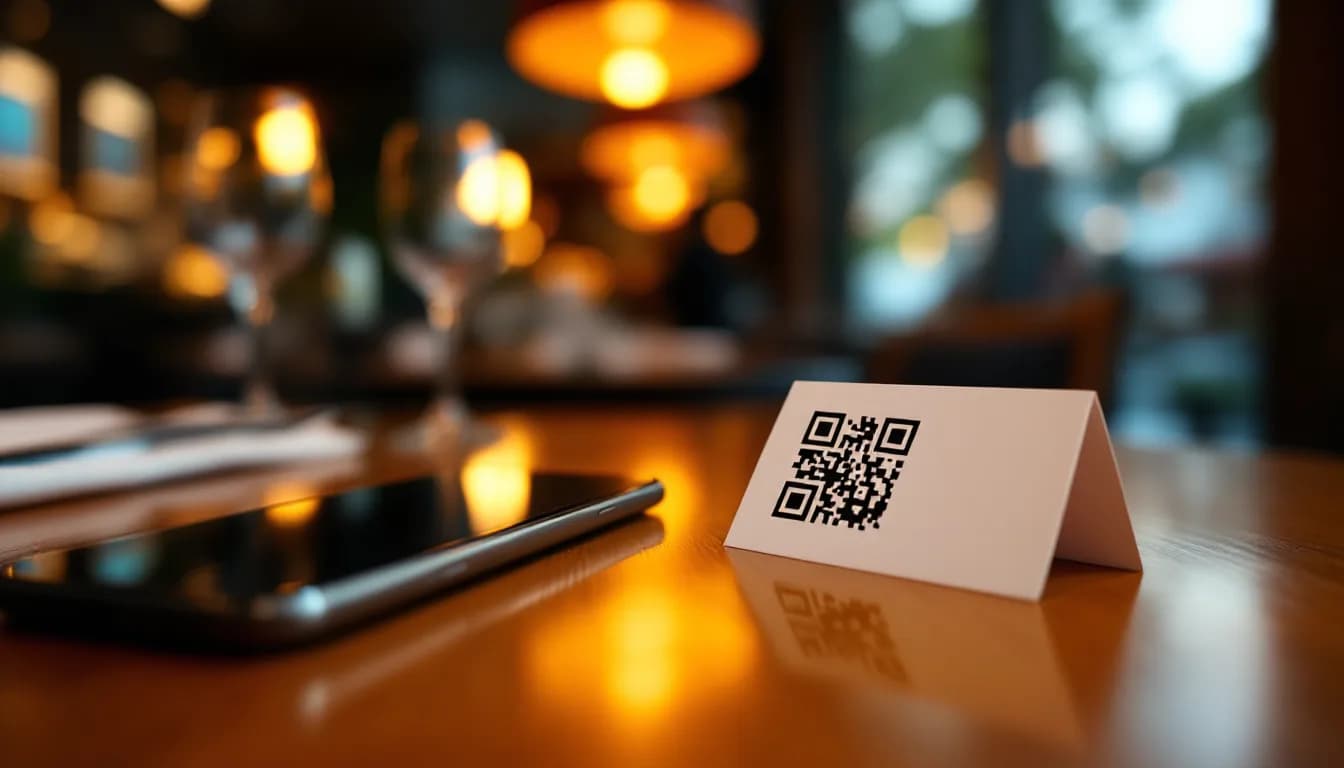
- —A static QR menu replicates the weakest version of a paper menu — it informs but does not convert. The right platform turns the same scan into an active upsell surface, review generator, and jukebox in one interaction.
- —Zero-friction design — no app download, no login, instant load in any mobile browser — is the prerequisite for any upsell to work. Every additional step between scan and content reduces the probability of guest engagement.
- —Timing and proximity drive review conversion: prompting a guest within the interface they already have open, at a moment of peak satisfaction, removes the friction that causes most guests to defer leaving a review until they forget.
- —PayPlay turns the guest app into a direct revenue line: guests pay to request tracks, the venue earns per request, with no dedicated hardware and no staff involvement per transaction.
- —MUSICDJ's background music is licensed for business streaming — but the venue's own local public-performance or PRO licence (SOKOJ, GEMA, PRS, SACEM, and equivalents) remains a separate, operator-held obligation that MUSICDJ does not replace.
- —Managing Background Music, Digital Signage, and CONNECT from one Backstage dashboard eliminates the coordination overhead that multiplies when these tools operate in isolation.
The Static QR Menu Problem Restaurants Cannot Afford to Ignore
The post-pandemic hospitality industry moved quickly to replace printed menus. For many venues, the solution was a QR code linking to a PDF or a basic listing page — functional, but frozen at the point of setup. Operators ticked the contactless box and moved on, leaving the upsell potential of the format almost entirely untouched.
The problem is structural. A static digital menu replicates the weakest version of a paper menu: it shows items, communicates prices, and stops. It cannot prompt a guest toward a premium option. It cannot surface a limited-time pairing suggestion. It cannot adapt to the time of day or the composition of the table. A guest scans, reads, closes the browser, and orders verbally — the interaction is informational and nothing more.
The contrast with an active scan is significant. A guest who scans and enters a structured, interactive guest web app does not just read — they are guided toward add-ons at the moment of highest purchase intent, invited to leave a Google review while the experience is fresh, and given real agency over the music in the room. The difference in incremental revenue and social proof between those two scan experiences is the core argument of this article.
Stated plainly: a qr code upsell restaurant strategy only works when the platform behind the code is built to convert. A zero-friction upsell hub captures incremental spend, social proof, and music revenue in a single interaction — no app download, no extra hardware, no additional staff action required.
Zero Friction Is the Foundation: Why No-Download Access Changes Conversion
Zero friction, in this context, has a precise meaning. A guest points a camera at a QR code and lands directly inside a branded, interactive web experience — no App Store prompt, no registration screen, no credentials, no meaningful loading delay. The scan is the entry. Nothing else stands between it and the content.
This matters because every additional step introduced between scan and content reduces the probability of guest engagement. A prompt to download an app is enough to end the interaction for a large share of guests. A login screen introduces friction that feels disproportionate to the task. Even a slow load — measured in seconds, not minutes — is enough to cause a guest to pocket the phone and order the way they always have.
The no-download guest web app model addresses this directly. The experience runs in any smartphone browser, loads quickly, requires no credentials, and delivers a fully branded, interactive session. From the guest's perspective, it is seamless. From the venue's perspective, it requires no app maintenance, no version compatibility management, and no guest support burden when an operating system update changes browser behaviour.
MUSICDJ CONNECT is the specific implementation of this model. One QR code surfaces the digital menu, real-time now-playing information, and Google review prompts within the same no-download guest web app. The guest never leaves that context. The upsell surface is wherever the guest is already looking.
The Menu as an Upsell Surface: Capturing Incremental Spend at the Moment of Decision
The moment a guest opens a menu, they have already committed to spending. The question is not whether to buy — it is what and how much. This is the optimal window for upsell prompts, and a well-structured digital menu sits precisely there.
A static menu cannot exploit that window. A structured, interactive digital menu can. Modifiers, premium alternatives, and contextual pairing suggestions can be surfaced within the browsing flow — at the exact point where a guest is weighing their options — rather than depending on a server to remember to mention them mid-service at a busy table. This is where a digital menu upsell strategy creates value that a paper menu or a PDF simply cannot replicate.
The most effective contactless menu revenue tips focus not on what you display, but on how the guest journey is structured around each item. AI menu generation, available within the MUSICDJ platform, helps venues build and maintain upsell-ready menu content without manual reformatting — reducing the ongoing effort of keeping guest-facing content accurate and commercially organised.
When digital signage for venues and the QR guest experience are managed from the same Backstage dashboard, a daily special updated in one place appears consistently across venue screens and the guest app alike. There is no risk of a guest reading one price on screen and a different one on their phone.
Scheduling and day-parting add another commercial layer — but these capabilities belong to Background Music and Digital Signage rather than the CONNECT guest app itself. Background music for restaurants can shift the room's atmosphere from a lunch tempo to an evening feel automatically, while Digital Signage can transition promotional messaging — from a set-menu prompt during lunch service to cocktail pairing language as the evening begins — without any manual staff intervention. The QR guest app operates within that environment; together, they form a coherent in-venue commercial layer managed from Backstage.
Social Proof on Demand: Turning Happy Guests Into Google Reviews
The timing of a review request is not incidental — it is the primary variable. A guest prompted at a moment of genuine satisfaction, while still in the venue and already holding their phone, is in a fundamentally different state than the same guest receiving an email the following afternoon. Behavioural friction research consistently shows that reducing steps and closing the gap between experience and request removes the most common reason guests do not follow through.
The CONNECT guest web app surfaces a Google review prompt within the same interface the guest is already using — the same screen they used to read the menu. There is no separate NFC card to tap, no printed prompt to notice, no staff member to make the ask. The prompt is part of the scan experience itself.
The compounding effect here is meaningful. Google review volume and recency are among the factors that influence local search ranking. A venue that consistently generates reviews through its guest app builds an organic discovery asset over time — with no additional workflow cost beyond the initial setup. The process is passive from the venue's perspective: no third-party review management platform, no dedicated workflow, no added management overhead.
Music as a Revenue Line: The PayPlay Guest Jukebox
A guest jukebox has historically required dedicated hardware — a physical unit, a payment terminal, a maintenance contract. The PayPlay guest jukebox is embedded within the CONNECT guest web app and operates through the same interface a guest used to read the menu. They browse available tracks, select a request, and pay — without a separate device, a different app, or any involvement from floor staff.
The appeal to guests is direct: genuine agency over the room's atmosphere, exercised from the screen they are already holding. For the operator, it is an additional income stream per cover that requires no dedicated hardware and no staff time per transaction.
One critical point for any venue considering music-related features: background music for restaurants on the MUSICDJ platform is licensed for business streaming use, but the venue retains its own obligation to hold a valid local public-performance or PRO licence — for example SOKOJ, GEMA, PRS, or SACEM, depending on territory. PayPlay does not replace or absorb that requirement. The two licensing layers are distinct, and operators should confirm their local compliance independently of their MUSICDJ subscription.
Beyond the direct revenue, there is a logical case for the jukebox as a dwell-time driver. A guest who has an active stake in the music — because they requested a track — has a concrete reason to remain in the venue until it plays and to re-engage with the app. That engagement supports longer visits and additional ordering opportunities, though the degree varies naturally by venue type and guest mix.
Connecting the Touchpoints: Now-Playing, Signage, and the Single-Dashboard Ecosystem
The now-playing feature within the CONNECT guest web app shows the current track in real time. This does more than satisfy curiosity. When a guest can see the track name and artist, the music becomes a legible part of the venue's identity rather than ambient background noise. It also serves as a natural entry point into PayPlay: the prompt-design logic here is straightforward — a guest who has relevant context already in front of them faces a lower cognitive cost to acting on it than one who encounters a generic call-to-action with no supporting information. This is a meaningful driver of restaurant qr code guest engagement with the jukebox feature.
When digital signage for venues and the CONNECT guest app are managed through the same Backstage dashboard, promotional content gains coherence across the room. A special updated once appears on screens and in the guest app simultaneously. The risk of inconsistency — a screen showing yesterday's offer while the guest app shows today's — is removed by the shared content source.
Operational efficiency is the underlying argument. A venue running background music for restaurants, Digital Signage, and CONNECT as disconnected tools faces a coordination overhead that grows with every update. Managing all three from Backstage means one login, one update cycle, and one less source of drift between what staff know, what screens show, and what guests see on their phones.
For venues that also run live TV alongside promotional content, IPTV adds another screen-management layer within the same interface — controlled from the same device the operator already uses for everything else.
Evaluating a QR Upsell Platform: What Actually Matters for Restaurants
Not every QR menu platform is built for upsell. Many are built for compliance — a way to present a menu digitally and move on. When assessing options as part of a broader restaurant upsell techniques review, these criteria separate a passive menu from a genuine revenue tool.
No-download access. Any requirement for an app install creates abandonment. The platform must operate in a mobile browser, without friction, from any device, with no login requirement.
Real-time content control. Menus, specials, and promotions must update instantly from a central dashboard. A platform that requires a developer intervention or file upload to change a daily special is not operationally viable for a busy venue.
Native review integration. Google review prompts should be embedded in the guest journey, appearing at the right moment within the interface the guest is already using — not managed through a separate tool with a separate login and a separate workflow.
Revenue-generating guest features. A passive digital menu is a cost centre. The right platform includes a mechanism — such as a guest jukebox — that turns the qr menu add-on sales opportunity into a direct income line for the operator.
Multi-zone and scheduling capability. A venue with more than one seating area or more than one service period needs content control that reflects that complexity, without multiplying management effort. Scheduling and zone management should be native to the platform, not manual workarounds.
MUSICDJ CONNECT is purpose-built around these criteria. It is not a generic QR tool with hospitality features bolted on — it is a platform designed from the ground up for venue operators who need one scan to do several jobs: present a structured menu, surface add-ons, generate Google reviews, earn music revenue, and reinforce the venue's brand identity, all within a no-download guest web app that requires no action from the floor team to function.
Static QR Menu vs Active QR Upsell Hub
| Feature | Static QR Menu | Active QR Upsell Hub (MUSICDJ CONNECT) |
|---|---|---|
| Guest access model | PDF link or basic web page; no interaction beyond scrolling | Branded no-download web app; instant access in any mobile browser, no registration required |
| Upsell capability | None — guests browse items and close the page | Structured digital menu with contextual add-on and pairing prompts at the moment of decision |
| Menu content updates | Manual file replacement or developer action required | Real-time from Backstage dashboard; changes appear instantly on guest devices |
| Google review prompts | Not included; requires a separate tool or staff ask | Embedded in the guest app at the optimal moment; no staff action required |
| Revenue generation beyond covers | None | PayPlay jukebox adds per-request income per cover; no dedicated hardware needed |
| Scheduling and day-parting | Not available | Background Music and Digital Signage scheduling managed from Backstage |
| Staff involvement per guest interaction | Required for all upsell prompts and review requests | Minimal; platform handles prompts, reviews, and jukebox transactions autonomously |
| Multi-zone content control | Not supported | Per-zone playlist and signage control via Backstage |
Frequently asked questions
Does MUSICDJ CONNECT work on all smartphones?
Yes. The guest web app runs in any modern mobile browser — Safari, Chrome, and their equivalents — without requiring a download or account registration. Guests scan the QR code and enter the experience immediately, regardless of device or operating system.
Does MUSICDJ handle my venue's public-performance licence?
No, and this distinction is important. MUSICDJ's background music is licensed for business streaming use. Your venue is still responsible for holding a valid local public-performance or PRO licence through the relevant collection society in your territory — for example SOKOJ in Serbia, GEMA in Germany, PRS in the UK, SACEM in France, or SIAE in Italy. These are two separate obligations, and MUSICDJ does not replace the local one.
What is PayPlay and how does the revenue model work?
PayPlay is the paid guest jukebox embedded within the MUSICDJ CONNECT guest web app. Guests browse available tracks and pay to request songs; the venue earns revenue from each accepted request. There is no dedicated hardware required and no staff involvement needed per transaction.
Can we update menu content in real time without technical help?
Yes. Menu content managed through the Backstage dashboard updates in real time. There is no file upload, no developer action, and no delay between when you make a change and when guests see it on their devices.
How does the Google review prompt appear to guests?
The review prompt surfaces within the CONNECT guest web app — the same interface the guest used to browse the menu. It appears as part of the existing scan experience, not as a separate step, a push notification, or a follow-up email. No staff action is required to trigger it.
Is CONNECT only suitable for restaurants, or does it work for bars and cafes too?
CONNECT is designed for hospitality venues broadly — restaurants, cafes, bars, and similar operations. The platform supports any venue that uses a menu-based service model and wants to add upsell prompts, Google review generation, and PayPlay jukebox functionality within a no-download guest app.
One QR Code. Multiple Revenue Streams.
See how MUSICDJ CONNECT turns a standard table QR code into a structured upsell surface, a review engine, and a jukebox — all without an app download, additional hardware, or extra staff.
Get Started with MUSICDJ