
Hotel Lobby Music: What to Play and Why It Matters
Hotel lobby music is not an aesthetic afterthought. It is an operational lever that shapes guest perception within seconds of arrival — and getting it wrong costs more than most operators realise.
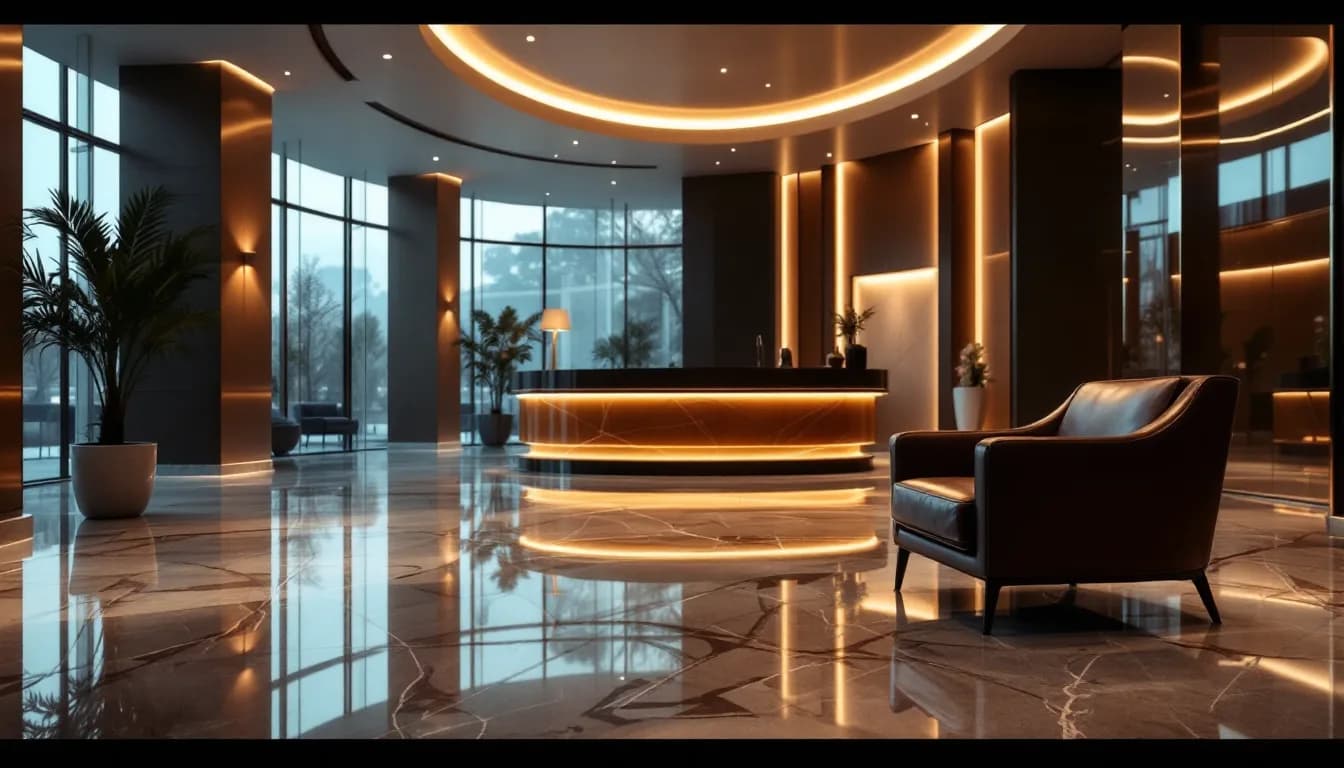
- —First impressions form within seconds of arrival; lobby music is the first sensory signal a guest receives and it colours the rest of the stay.
- —Tempo, volume, and genre each trigger distinct emotional responses — even in guests who are not consciously listening.
- —Day-parting (scheduling different music moods across morning, midday, afternoon, and evening) is essential for a lobby that serves multiple guest populations throughout the day.
- —Volume calibration must be tested from the entrance, the check-in desk, and the seating area — not set once and forgotten.
- —Playing music in a hotel lobby requires both a business-licensed streaming service and a separate local public-performance licence from your national collecting society. These are two distinct obligations.
- —Technology — per-zone scheduling, remote control, and automated day-parting — is what turns good intentions into consistent execution across shifts and properties.
Why Hotel Lobby Music Is an Operational Decision, Not a Playlist
The lobby is the first sensory touchpoint a guest encounters after stepping through the door. Before they reach the front desk, before any words are exchanged, sound has already begun shaping whether they feel welcomed, at ease, or vaguely unsettled. That impression forms fast — and it colours every interaction that follows.
Most hotel operators understand this in principle. In practice, lobby music is still treated as a secondary concern: a Spotify playlist left running on a tablet, a radio station chosen by whoever opened that morning, or a streaming service designed for personal listening rather than commercial deployment. The gap between what managers know and what they actually implement is where guest experience quietly erodes.
Framing hotel lobby music as a branding and operations tool — rather than background decoration — changes how you budget for it, brief your team on it, and evaluate whether it is working. It belongs in the same conversation as front-desk training and lobby design, not in the same conversation as which scented candle to buy.
The cost of getting it wrong is real. Negative reviews citing 'atmosphere' or 'noise' are more common than most operators acknowledge. Staff stress increases measurably when the ambient tempo is too fast or the volume too high for sustained periods. And a misaligned soundtrack can undermine thousands spent on interior design and marketing by signalling the wrong brand identity to the very guests you are trying to attract.
The Psychology Behind What Guests Hear the Moment They Walk In
Atmospheric research consistently shows that tempo, volume, and genre each trigger distinct emotional and physiological responses — even when listeners are not consciously paying attention to the music. This is not a marginal effect. It is robust enough to influence dwell time, perceived wait duration, and reported satisfaction.
Some practical implications for hotel lobbies:
- Tempo: Slow-to-moderate tempos — roughly 60 to 80 BPM — correlate with a calmer, more expansive sense of space and reduced perceived wait time at reception. Faster tempos increase arousal, which is useful in some contexts but counterproductive when a guest has just arrived after a long journey.
- Genre and social identity: Genre signals belonging. A boutique design hotel playing the same playlist as a budget chain creates cognitive dissonance that erodes perceived value, regardless of how good the physical product is. Guests may not articulate this consciously, but it registers.
- Volume: Volume calibration matters as much as song selection. Music that forces guests to raise their voices at the check-in desk increases stress for both the guest and the staff member handling the conversation. The front desk is not the place for the music to assert itself.
- Congruence: Studies on retail and hospitality atmospherics suggest that music congruent with a venue's visual identity and target demographic increases dwell time and reported satisfaction, while incongruent music produces the opposite effect. The music should feel like it belongs in the room.
Matching Music to Lobby Type: A Practical Framework
There is no single correct answer for hotel lobby music — the right choice depends on the property type, the guest profile, and the brand positioning. The framework below is a starting point, not a rigid prescription.
Luxury and boutique hotels
Prioritise curated, genre-coherent playlists — contemporary classical, ambient electronic, or sophisticated jazz — at low-to-moderate volume. The music should be felt rather than heard. It creates atmosphere without competing for attention.
Business and airport hotels
Guests arriving at business properties are often stressed and time-pressured. Moderate-tempo, neutral, internationally familiar music reduces friction without demanding attention. Avoid anything too culturally specific or rhythmically insistent.
Lifestyle and design hotels
The playlist is part of the brand story here. Bolder genre choices — indie, nu-jazz, world music — are appropriate when they authentically reflect the property's positioning. The key word is authentically: the music should feel like a deliberate editorial choice, not a random shuffle.
Budget and economy properties
Music still matters at this end of the market. Clean, upbeat, mid-tempo playlists signal professionalism and care even when the physical product is modest. A well-chosen soundtrack communicates that the property takes its guests seriously.
Resort and leisure hotels
Energy can be higher, particularly in late morning and early afternoon when guests are heading out or returning from activities. Warmer, more rhythmic choices work well for guests in leisure mode.
The framework principle: define the emotional state your guest is likely to arrive in, define the emotional state you want them in within two minutes, and choose music that bridges that gap.
Day-Parting: Why the Same Playlist Should Not Run All Day
A hotel lobby serves different guest populations at different hours. The guest checking out at 6:30 in the morning has different needs from the leisure guest arriving at 2 in the afternoon, who in turn has different needs from the group gathering in the lobby bar at 9 in the evening. A single playlist cannot serve all three well.
Day-parting means scheduling distinct playlists or music moods for defined time windows. A practical structure for most properties:
- Morning (6:00–10:00): Softer, slower, acoustic or instrumental. Guests are often groggy; the lobby is a transitional space between sleep and the day. The music should ease rather than energise.
- Midday and afternoon (10:00–17:00): Moderate energy, slightly higher tempo. The lobby is at its busiest; the music should hold the room and create atmosphere without dominating conversation.
- Evening (17:00 onwards): Warmer, richer, more atmospheric. If the lobby has a bar or lounge function, music can take on a more prominent role as ambient sound levels rise and the social register shifts.
The operational challenge with day-parting is consistency. Relying on staff to remember to change playlists across shifts introduces variability that accumulates into a noticeably inconsistent guest experience. Automated scheduling removes that dependency.
MUSICDJ's background music for hospitality venues supports day-parting and per-zone scheduling through the Backstage dashboard, so the lobby, bar, restaurant, and spa each run the right programme at the right time without manual intervention.
Volume, Acoustics, and the Mistakes Most Hotels Make
Hard surfaces — marble, glass, polished concrete — are common in hotel lobbies because they photograph well and are easy to maintain. They also reflect sound aggressively. Music calibrated for a carpeted, soft-furnished room will feel noticeably louder and harsher in a hard-surface atrium.
The most common volume mistake is setting the level at the front desk, where staff stand for hours and naturally want it lower, rather than at the guest arrival point near the entrance, where the acoustic conditions and the guest's psychological state are quite different.
A practical calibration test:
- Stand at the main entrance as a guest would arrive.
- Move to the check-in desk and hold a normal conversation.
- Sit in the lobby seating area.
The music should feel comfortable at all three positions without being inaudible at any of them. If a guest has to repeat themselves at the front desk, the volume is too high — full stop.
Speaker placement compounds the problem. A single speaker system trying to serve a large lobby will always be too loud somewhere and too quiet elsewhere. Multi-zone setups with independent volume control per area solve this structurally rather than through constant manual adjustment.
MUSICDJ supports per-zone playback control, allowing the entrance area, reception desk zone, and lounge seating to be managed independently from a single interface — or adjusted in real time from a phone.
Licensing: What Hotels Actually Need to Know
Playing music in a hotel lobby is a public performance. It requires the appropriate licence from the relevant collecting society in your territory. This is not optional, and the consequences of non-compliance — fines, back-payments, reputational risk — are a standard operational hazard for properties that assume a streaming subscription covers everything.
The relevant societies vary by country: SOKOJ in Serbia, GEMA in Germany, SACEM in France, PRS and PPL in the UK, SIAE in Italy, SGAE in Spain, ZAMP in Croatia, and their equivalents elsewhere. Each has its own tariff structure, typically based on the number of rooms and the nature of the public spaces.
MUSICDJ provides a business-licensed music streaming service. This means the repertoire is cleared for commercial use — but it does not replace the hotel's own public-performance obligation with its national collecting society. These are two separate licences covering two separate legal relationships.
The split, clearly stated:
- MUSICDJ handles the streaming licence with rights holders, ensuring the music library is appropriate for business deployment.
- The hotel handles the local public-performance licence with its national collecting society.
Hotels that assume one subscription covers both obligations are exposed to compliance risk. The practical step is straightforward: contact your national collecting society, declare your public spaces and room count, and pay the appropriate tariff. It is a standard operational cost, not an exceptional one, and it protects the property from a category of risk that is entirely avoidable.
Technology That Makes Consistent Lobby Music Achievable
Knowing what good hotel lobby music sounds like is the easy part. Delivering it consistently — across shifts, across seasons, and across multiple properties — is a technology and workflow problem.
The tools that make this achievable in practice:
- MUSICDJ Backstage: a single dashboard for managing playlists, schedules, zones, and signage across one venue or many. Changes made centrally propagate immediately.
- Per-zone scheduling: lobby, restaurant, spa, and gym each run independent programmes from one interface, without requiring separate hardware or logins.
- Web radio integration: for properties that prefer curated live streams as an alternative or supplement to static playlists.
- [AI-generated jingles and branded audio](/ai): real-time branded audio moments — seasonal greetings, event announcements, promotional messages — that insert cleanly into the music schedule without breaking the atmosphere.
- Remote control via iOS, Android, and web apps: managers or front-desk staff can adjust volume or switch playlists from a phone without accessing the back-of-house system. This matters during a private event, a VIP arrival, or any moment when the default programme needs to flex.
- Android and Windows players: the system runs on hardware the property may already own, which reduces deployment cost and simplifies IT requirements.
For small hotels, guesthouses, and apartment-style properties, MUSICDJ STAY for hotels and guesthouses extends the same music and guest experience logic into individual rooms via a branded in-room guest app and TV system. The licence model is a one-time per-room purchase with no monthly platform fee — a meaningful structural difference for properties managing tight margins.
Connecting Lobby Music to the Broader Guest Experience
Lobby music does not exist in isolation. It is the opening note of a sensory composition that continues through the restaurant, bar, spa, gym, corridors, and guest rooms. Each touchpoint either reinforces or undermines the impression created in the first thirty seconds of arrival.
Several ways to extend the lobby music strategy into a coherent guest experience:
- Turn the music into a conversation point: MUSICDJ CONNECT's guest-facing digital menu and now-playing app allows guests to see what is playing via a QR-accessible web app — no download required. Music that was invisible wallpaper becomes a brand asset and a point of engagement.
- Align visual and audio atmosphere: digital signage for hotel lobbies can reinforce the mood set by the music. A calm, ambient playlist paired with slow-moving visual content on lobby screens creates a unified sensory environment. Jarring mismatches between energetic visuals and quiet music — or vice versa — undermine both.
- Maintain consistency into the room: for properties using MUSICDJ STAY, the in-room guest app and 24/7 AI guest agent extend the property's hospitality logic beyond the lobby and into the room, maintaining brand consistency throughout the stay and reducing pressure on front-desk staff for routine guest queries.
The strategic point is simple: the lobby sets the tone, but the tone has to hold. Every subsequent touchpoint is either a confirmation or a contradiction of the promise made in those first two minutes. Hotel lobby music, done well, is the most cost-effective tool available for making that promise land.
Consumer Streaming vs. Business Music Platform: What Hotels Actually Need
| Feature / Consideration | Consumer Streaming Service | Business Music Platform (e.g. MUSICDJ) |
|---|---|---|
| Licensed for public performance in commercial venues | No — personal use only | Yes — cleared for business deployment |
| Replaces local PRO / collecting society obligation | No | No — both licences are always required |
| Per-zone scheduling and day-parting | Not available | Supported via Backstage dashboard |
| Multi-property central management | Not available | Single dashboard across all venues |
| Remote volume and playlist control via mobile app | Limited / not designed for staff use | iOS, Android, and web remote apps included |
| AI jingles and branded audio insertions | Not available | Supported |
| Integration with digital signage | Not available | Supported via MUSICDJ Digital Signage |
| In-room guest experience extension | Not available | MUSICDJ STAY (one-time per-room licence) |
| Compliance risk for the venue | High — terms of service prohibit commercial use | Low — music library is commercially licensed |
Frequently asked questions
What kind of music works best in a hotel lobby?
The right choice depends on the property type, guest profile, and brand positioning. Luxury and boutique hotels typically benefit from curated, genre-coherent playlists at low-to-moderate volume — contemporary classical, ambient electronic, or sophisticated jazz. Business hotels suit moderate-tempo, internationally neutral music. Lifestyle properties can use bolder genre choices when they authentically reflect the brand. The consistent principle across all types is congruence: the music should feel like it belongs in the room and match the emotional state you want guests to arrive in.
Do I need a special licence to play music in my hotel lobby?
Yes. Playing music in a hotel lobby is a public performance and requires a licence from the relevant collecting society in your territory — for example, PRS and PPL in the UK, GEMA in Germany, SACEM in France, SOKOJ in Serbia, or SIAE in Italy. Using a business-licensed streaming service like MUSICDJ covers the streaming licence with rights holders, but it does not replace your local public-performance obligation. Both licences are required, and they cover separate legal relationships. Contact your national collecting society to declare your public spaces and pay the appropriate tariff.
What is day-parting and why does it matter for hotel lobbies?
Day-parting means scheduling distinct playlists or music moods for defined time windows across the day — typically morning, midday, afternoon, and evening blocks. It matters because a hotel lobby serves different guest populations at different hours, each with different emotional states and needs. A single playlist running all day cannot serve a 6 AM departure, a 2 PM leisure arrival, and a 9 PM lobby bar gathering equally well. Automated scheduling ensures the right music plays at the right time without relying on staff to remember to make changes across shifts.
How loud should lobby music be?
A practical test: stand at the main entrance, then at the check-in desk, then in the lobby seating area. The music should feel comfortable at all three positions without being inaudible at any of them. The key rule is that music should never force a guest to repeat themselves at the front desk — if it does, the volume is too high. Hard-surface lobbies (marble, glass, polished concrete) reflect sound and amplify perceived volume, so calibration must account for the room's acoustic properties, not just the output level.
Can small hotels and guesthouses use the same music management tools as larger properties?
Yes. MUSICDJ STAY is designed specifically for small hotels, guesthouses, apartments, and Airbnb-style rentals. It provides a branded in-room guest app, an in-room TV system, and access to the same scheduling and zone management tools available to larger properties. The licence model is a one-time per-room purchase with no monthly platform fee, which makes it structurally suitable for properties managing tighter margins.
Can guests find out what is playing in the lobby?
Yes, if the property uses MUSICDJ CONNECT. Guests can scan a QR code to access a no-download web app that shows what is currently playing, alongside the digital menu and a Google review prompt. This turns the background music into an active brand touchpoint rather than invisible wallpaper.
Ready to Make Your Lobby Music Work as Hard as the Rest of Your Operation?
MUSICDJ gives hotel operators the scheduling, zoning, and remote control tools to deliver consistent, on-brand background music across every area of the property — from the lobby at 6 AM to the bar at midnight. Explore the platform or get started today.
Get Started with MUSICDJ