
AI Chatbots for Restaurants: Reservations, FAQs and Menus
A standalone booking widget solves one problem. An AI guest agent embedded inside the same platform running your venue's digital menu, music, and signage solves the right one. Here is what to evaluate, what to avoid, and how to choose.
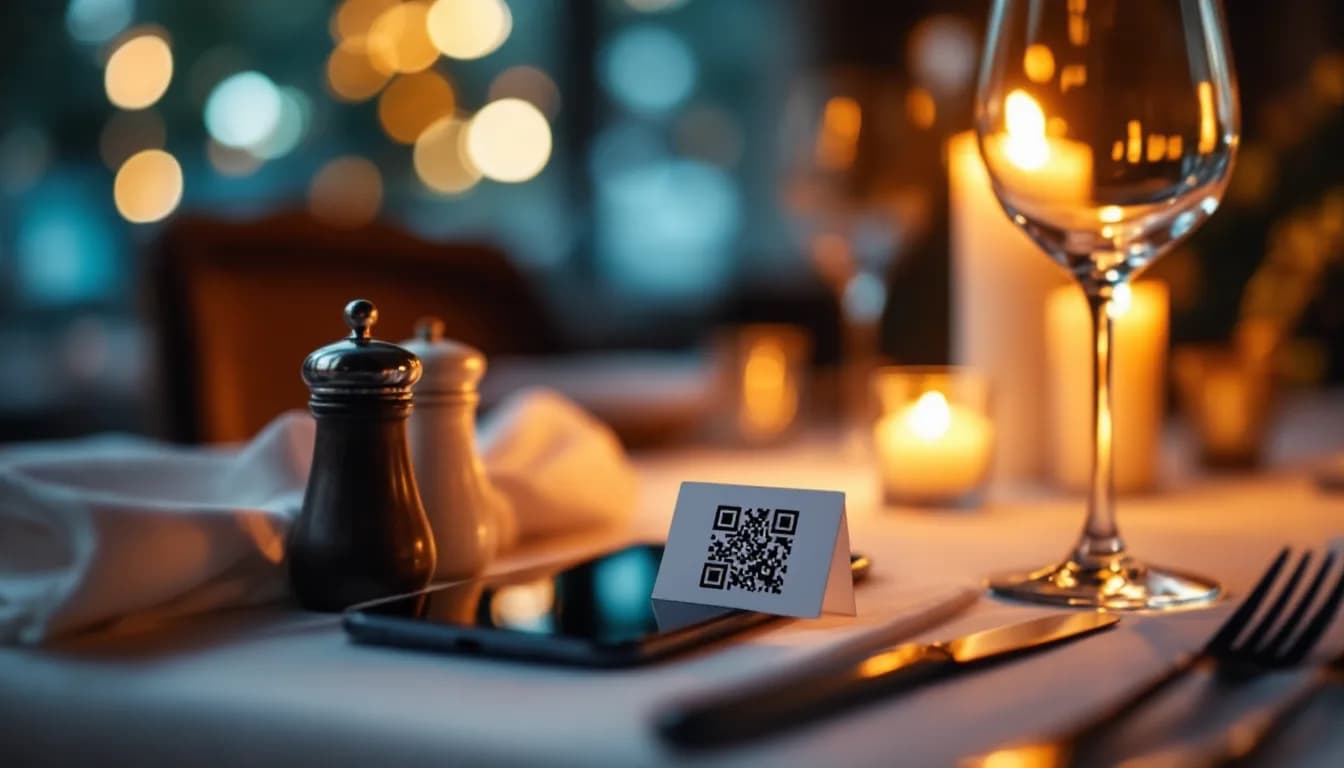
- —An AI chatbot for restaurants delivers its greatest operational value against three interaction types: FAQs, reservation inquiries, and menu browsing — the high-volume, low-complexity contacts that fragment staff attention during peak service.
- —A restaurant chatbot is only as reliable as its data source; the critical question for any vendor is how and on what timeframe the AI reflects changes to your menu, hours, and allergen information — confirm this before signing.
- —Unified-platform AI agents reduce the conditions that cause sync drift, but operators should verify the specific update mechanism with MUSICDJ for menu and allergen-sensitive queries before deployment.
- —MUSICDJ licenses music for business use; your venue's local public-performance obligations to bodies such as PRS, GEMA, SOKOJ, SACEM, or equivalent are separate and remain your responsibility.
- —Before adding any new AI tool, audit your existing digital stack: count the dashboards, subscriptions, and manual sync tasks it already requires — the comparison with a unified platform is often more compelling than a feature-level price analysis.
What an AI chatbot for restaurants actually does
An AI chatbot for restaurants is a conversational interface — typically accessed via QR code or web link, requiring no app download — that handles guest questions, surfaces menu information, and manages routine interactions around the clock without demanding staff attention.
The concept is straightforward. What matters operationally is what sits behind the interface.
Guests arrive expecting three things from any restaurant chatbot: answers to FAQs (hours, allergens, dress code, parking, events), the ability to ask reservation or table availability questions in natural language, and access to menu information at the precise moment they are deciding whether to book or what to order.
A chatbot is only as reliable as the information it draws from. A guest agent connected to live venue data answers correctly. An agent trained on a static PDF or updated by periodic manual upload answers confidently from whatever it was last told — and the gap between those two states is where guest trust erodes.
The argument this article makes is not that standalone chatbot widgets are worthless. It is that the durable operational advantage comes from an AI guest and concierge agent embedded inside the same platform already running the venue's digital menu, music, and signage — one coherent system rather than a patchwork of disconnected tools.
The three guest interactions every restaurant needs to automate
Reservations and table inquiries
Guests increasingly expect to ask 'can I book a table for four on Friday evening?' in natural language and receive an immediate, accurate response. A voicemail box, a redirect to a third-party booking site, or an inquiry form with a 24-hour response window are not answers — they are friction points that push a guest toward a competitor with a faster path to confirmation.
Frequently asked questions
Opening hours, seasonal menu availability, allergen and dietary information, WiFi details, parking, accessibility provisions, private dining, and upcoming events represent a predictable, high-volume contact load with a finite answer set. This is the category where a well-designed restaurant AI agent performs most reliably: the question space is bounded, the correct answers are known, and the volume is high enough that automating it measurably reduces the interruptions that fragment a manager's attention during peak service.
The return on automating FAQ handling is also among the most defensible investments a restaurant operator can make in front-of-house efficiency. A guest who receives an instant, accurate response to 'do you have gluten-free options?' is better served than one who waits for a callback or chases a reply to an email form.
Menu browsing and order context
Guests arriving at the table — or weighing a reservation from home — want to explore dishes, understand composition, and in venues that enable it, interact with the menu in a way that does not involve scrolling a PDF or waiting for a server to recite specials. An AI menu assistant that surfaces dish descriptions, ingredients, and dietary flags conversationally serves the guest at the moment of decision.
A point worth stating clearly: this article addresses the AI agent's role in menu information and order context — what is available, what is in a dish, what alternatives exist for a specific dietary need. Actual order placement involves separate integrations and workflows; evaluate any vendor's claims in that area carefully against what their product concretely supports.
Secondary interactions that compound the value
Beyond the three core functions, an AI guest assistant for restaurants also delivers value by routing satisfied diners toward Google reviews at the right post-meal moment, communicating daily specials without reprinting menus, and — in venues that enable it — letting guests engage with a song jukebox. All from a single QR-accessed touchpoint.
The goal throughout is not to replace hospitality staff. It is to absorb the low-complexity, high-repetition interactions that fragment a host's or manager's attention during peak service, so the team's judgment is available for the situations that actually require it.
Why standalone restaurant chatbot widgets consistently underdeliver
The isolated widget problem
Most commercially available restaurant chatbots are deployed as scripts bolted onto a website or a third-party booking platform, maintaining their own data store that must be manually synchronised with the actual menu, hours, and policies. When everything is current, the widget functions. The question is what happens when something changes.
Sync drift and its consequences
When the kitchen removes a dish, changes a price, or updates an allergen, the standalone chatbot does not automatically know. It answers from its last configured state — which may be days or weeks old depending on how frequently the venue re-trains or updates it. For minor errors, the consequence is a guest mildly misled about an out-of-season dish. For allergen mis-statements, the consequences can be significantly more serious for both the guest and the venue's liability position.
The multi-dashboard burden
A venue running a separate booking widget, a standalone digital menu platform, a music streaming service, and a digital signage system manages multiple vendor relationships, billing cycles, and support contacts — any of which can present contradictory information to guests. The operational overhead of maintaining that stack is real, and it scales poorly as the venue grows or adds sites.
No unified guest journey
A guest who browses the menu via a QR app, queries a chatbot about allergens, and reads a promotions board on the wall is interacting with three systems that share no context with each other. The experience is fragmented even when each individual tool functions correctly. Guests cannot see the seams between your systems — but they feel it when the answers do not add up.
Escalation paths that do not match how operators work
When a standalone chatbot cannot answer, the default fallback is typically an email form or support ticket — not the channel a working restaurateur actually monitors during service. The escalation design of any automated system is as important as what it can answer autonomously, and it is one of the dimensions most commonly underexamined before purchase.
The embedded AI guest agent: why platform context is the real differentiator
Architecture over interface
A well-designed restaurant AI agent built into the same platform already managing the venue's background music, digital signage, and digital menu operates from a more coherent data architecture than a disconnected widget. Fewer data silos means fewer conditions under which sync drift can occur — but whether and how quickly the AI accesses updated venue information is a specific technical question worth confirming with any vendor before committing.
How MUSICDJ's AI sits within a unified platform
MUSICDJ's AI guest and concierge agent, AI-generated menu content, CONNECT digital menu and guest web app, background music, and digital signage all operate from a single Backstage dashboard. A change made within that environment does not require separate communication to a music scheduler or signage system running in a different vendor's cloud — the platform context is shared.
Whether and on what timeframe the AI agent accesses updated menu or venue information is something prospective operators should confirm directly with MUSICDJ before deployment, particularly where allergen accuracy carries compliance weight. What the architecture avoids is the manual synchronisation task between entirely separate vendor systems that defines the standalone widget model.
Escalation design: an honest evaluation criterion
How an AI guest agent handles requests it cannot or should not resolve autonomously is one of the most important and least-examined dimensions when evaluating any chatbot for hospitality venues. The right mechanism depends entirely on how the operator works during live service: a channel monitored in real time is categorically more useful than an email queue that waits hours for a reply.
MUSICDJ documents a WhatsApp handoff to the owner for the AI guest agent within its STAY hotel product. The escalation mechanism for restaurant and cafe deployments is not specified in the public product documentation — this is a practical question to raise with MUSICDJ directly before committing to any automated guest workflow in a restaurant context.
Backstage as the single management interface
Staff learn one dashboard for scheduling music, updating signage content, managing the digital menu, and reviewing AI guest interactions. For small teams where the same person often handles front-of-house, music scheduling, and marketing simultaneously, that reduction in context-switching is a meaningful operational gain.
The commercial case for consolidation
For independent restaurants, cafes, and bars, the cumulative cost and complexity of maintaining separate point solutions is a meaningful burden. A restaurant AI concierge that is native to a broader platform — rather than a seventh vendor relationship bolted onto an existing stack — changes the unit economics of automation for venues that cannot afford a dedicated operations team. Not because any single feature is dramatically cheaper, but because the management overhead across the stack shrinks.
How a unified platform shapes the guest experience from arrival to review
A QR code on the table or at the entrance opens CONNECT — a no-download guest web app — surfacing the live digital menu, current promotions, and the AI agent in one branded, frictionless interface. No app download, no account creation, no navigation away from the venue's digital presence.
AI-generated menu content managed through the platform can be maintained without re-entry across separate systems. Whether that content feeds the AI agent directly, and on what update cycle, is a deployment detail to verify with MUSICDJ — particularly where dietary or allergen accuracy carries compliance weight.
While the guest interacts with the AI agent on their phone, the room's digital signage and background music — both managed from the same Backstage — set a consistent atmosphere. The AI layer complements the room experience rather than running in isolation from it.
CONNECT's built-in Google review prompt within the guest-facing app means a satisfied diner can be guided from a conversational AI post-meal moment directly to leaving a review, without exiting the venue's branded experience for a generic third-party platform.
For venues that enable the guest song jukebox, the same QR entry point delivering menus and AI answers also lets guests participate in what plays — one touchpoint serving multiple forms of guest engagement without additional apps or hardware.
What to evaluate when choosing an AI chatbot for your restaurant
Data currency first. When you update a menu item, how quickly does the AI agent reflect that change, and through what mechanism? Ask this question before signing. Platform architecture that shares context across tools is structurally less exposed to sync drift — but the specific answer matters for venues where allergen accuracy has direct compliance implications.
Escalation design that matches how you actually work. When the AI cannot or should not answer, where does the conversation go? A real-time handoff to a human via a channel you monitor during service is materially more useful than an email queue. Confirm the specific escalation mechanism for restaurant deployments directly with MUSICDJ before committing to any deployment.
Guest friction at the entry point. Does the guest need to download an app, create an account, or navigate away from your venue's digital presence? No-download, QR-accessible web apps remove the most common barrier to in-venue digital engagement, particularly for guests who are already seated and deciding.
Platform integration versus point solution. Count the dashboards, billing cycles, and vendor contacts your current stack already requires before adding another. Evaluate whether a chatbot purchase creates a new data silo with its own maintenance obligations or extends a platform you already manage.
Scope honesty from the vendor. A well-designed AI agent handles a defined set of interactions reliably and hands off everything else. Be cautious of vendors who overstate automation capability or imply the system replaces the judgment of experienced hospitality staff in complex or sensitive situations.
Music licensing transparency. If the platform also provides background music, confirm precisely what the licensing covers. MUSICDJ licenses music for business use, but venues remain responsible for their own local public-performance obligations — fees to PRS, GEMA, SOKOJ, SACEM, SIAE, ZAMP, or equivalent bodies in their territory. Any vendor implying otherwise should be questioned carefully.
Moving from a patchwork of tools to an integrated AI guest agent: practical next steps
Audit your current digital stack before adding anything. List every guest-facing touchpoint the venue currently operates — booking widget, digital menu, website chat, music service, signage system — and count the dashboards, subscriptions, manual sync tasks, and vendor contacts they collectively require. The picture that emerges is often more clarifying than a feature matrix.
Identify the highest-value automation target first. For most independent restaurants, it is FAQ and menu information: highest volume, most finite answer set, lowest complexity. Validate that layer before expanding scope to reservation guidance or order context.
Evaluate a unified platform against the true total cost of your current stack. Measure not just subscription fees but the staff time spent on manual updates, the errors generated by sync drift, and the guest-experience cost of a fragmented journey. The comparison is often more compelling than a line-item price analysis.
Design the guest journey before deployment. Map the QR entry point, the AI interaction scope, the escalation path, and the post-visit review prompt as a deliberate sequence before going live. A coherent guest experience requires intentional design, not just software activation.
Explore MUSICDJ's AI capabilities at /ai, the CONNECT digital menu and guest web app at /solutions/connect, and get started with MUSICDJ at /get-started.
Standalone chatbot widget vs embedded AI guest agent: key differences
| Feature | Standalone Chatbot Widget | Embedded AI Guest Agent (MUSICDJ) |
|---|---|---|
| Menu accuracy after a change | Requires manual re-sync; answers reflect last configured state until updated | Platform architecture reduces sync conditions; confirm exact update mechanism and timing with MUSICDJ before deployment |
| Guest entry friction | Often requires navigation to an external site or separate booking platform | No-download QR-accessed web app via CONNECT — browser only, no account required |
| Dashboard overhead | Separate login, billing cycle, and support contact alongside existing tools | Single Backstage dashboard shared with background music, signage, and digital menu |
| Allergen risk on menu change | Chatbot answers from stale data until manually corrected — potential liability exposure | Reduced by shared-platform architecture; verify update frequency and mechanism with MUSICDJ before any allergen-critical deployment |
| Escalation path | Typically email form or support ticket; often unmonitored during live service | Escalation mechanism for restaurant deployments not publicly specified — confirm with MUSICDJ before committing |
| Vendor relationships | Additional vendor, contract, and support contact alongside existing tools | Consolidated within the existing MUSICDJ platform relationship |
Frequently asked questions
Do guests need to download an app to use the restaurant AI guest agent?
No. MUSICDJ's CONNECT is a no-download guest web app accessed via QR code. Guests open it in their phone's browser without installing anything or creating an account, which removes the most common barrier to in-venue digital engagement.
What is the difference between CONNECT and the AI guest and concierge agent?
CONNECT is the digital menu and guest web app — the QR-accessible interface through which guests browse menus, access Google reviews, and interact with the venue's digital presence. The AI guest and concierge agent is a conversational layer that can handle questions within that environment. They are distinct components of the same platform, not interchangeable terms.
How does the AI agent handle questions it cannot answer?
The escalation mechanism varies by product and deployment context. MUSICDJ documents a WhatsApp handoff to the owner for its STAY hotel product. For restaurant and cafe deployments, the escalation path is not specified in the public product documentation — raise this question with MUSICDJ directly before deploying in any context where real-time staff notification during service matters.
Does MUSICDJ's background music subscription cover my venue's public-performance fees?
No. MUSICDJ licenses music for business use, which covers streaming rights for content on the platform. Your venue's obligation to pay local public-performance fees — to bodies such as PRS, GEMA, SOKOJ, SACEM, SIAE, ZAMP, or the equivalent in your territory — is entirely separate and remains your responsibility. These are different types of licensing, and no business music platform removes the PRO or PPL obligation.
Can the AI agent process food orders, or does it only provide menu information?
MUSICDJ's AI guest and concierge agent is documented as handling guest questions and conversational interactions — menu information, FAQs, reservation inquiries, and order context such as dish composition and dietary alternatives. Actual order placement involves separate integrations and workflows not listed in the product specification. If order-processing automation is a requirement for your venue, confirm the specific capabilities available directly with MUSICDJ before committing.
One platform. One guest experience.
Explore how MUSICDJ's AI guest agent, digital menu, background music, and signage tools work from a single dashboard — and replace a stack of disconnected tools with one coherent system.
Get started with MUSICDJ