Allergens on the Menu: EU-14 Rules and How to Show Them Digitally
EU Regulation No 1169/2011 requires every catering venue to disclose the fourteen major allergens before a guest orders. This guide explains what the law demands, why paper menus make ongoing compliance structurally fragile, and how a no-download digital QR menu lets operators update allergen data instantly — turning a legal obligation into a genuine guest-experience advantage.
- —EU Regulation No 1169/2011 requires catering venues to disclose all fourteen major allergens for every dish before the purchase decision is made — not just for pre-packaged food.
- —Paper menus become a compliance liability the moment a single ingredient changes; the reprint cycle introduces version drift, human error, and recurring cost.
- —A no-download digital QR menu connects every table to a single, always-current allergen record — eliminating the gap between what the kitchen serves and what the guest reads.
- —Dish-level allergen disclosure, plain-language descriptions, and a clear cross-contamination notice are the operational gold standard under EU FIC.
- —MUSICDJ CONNECT delivers a no-download guest web app with live menu and allergen information; MUSICDJ Background Music in the same venue is licensed for business use, but the venue must still hold its own local public-performance licence (e.g. SOKOJ, GEMA, PRS, SACEM).
- —Transparent allergen communication is a competitive differentiator: it earns trust from guests with allergies, influences group booking decisions, and reduces front-of-house training pressure.
What the EU-14 Allergens Are and Why the List Exists
The fourteen major allergens — commonly called the EU-14 — are mandated for disclosure under EU Regulation No 1169/2011 on the Provision of Food Information to Consumers (FIC), which came into force for catering establishments in December 2014. The regulation exists because allergic reactions to these substances range from mild discomfort to life-threatening anaphylaxis, and consistent, accessible labelling gives consumers with medically confirmed allergies or intolerances the information they need to make safe choices.
The fourteen allergens are:
- Gluten-containing cereals — wheat, rye, barley, and oats
- Crustaceans — prawns, crabs, lobster, crayfish
- Eggs
- Fish
- Peanuts
- Soybeans
- Milk — including lactose, cream, butter, and cheese
- Tree nuts — almonds, hazelnuts, walnuts, cashews, pecans, pistachios, macadamia/Queensland nuts, and Brazil nuts
- Celery and celeriac
- Mustard
- Sesame seeds
- Sulphur dioxide and sulphites at concentrations above 10 mg/kg or 10 mg/L
- Lupin
- Molluscs — clams, mussels, oysters, scallops, squid
A point that catches many restaurant and café operators off-guard: the regulation does not apply only to pre-packaged goods on a supermarket shelf. It applies equally to food sold loose or served in catering establishments. If you are running a restaurant, a café, a bar, or any hospitality venue where food is served, the obligation applies to you.
Operators in the United Kingdom should note that an equivalent framework was retained post-Brexit — UK FIC and, for pre-packed food for direct sale, Natasha's Law. The scope and mechanics differ in certain respects, and EU member states may also have supplementary national guidance layered on top of the base regulation. Operators should verify the rules that apply in their specific jurisdiction rather than relying solely on the EU text.
A note on music licensing: If you also play background music in your venue, MUSICDJ's business music service is licensed for commercial use — but your venue still holds its own obligation to pay the relevant local public-performance licence (such as SOKOJ, GEMA, PRS, or SACEM). Managing music and menus from one dashboard does not consolidate those separate regulatory duties.
Exactly What the Law Requires of Hospitality Venues
The core obligation under EU FIC for non-pre-packaged food served in catering is this: allergen information must be available and easily accessible to the guest before the purchase decision is made. The regulation does not prescribe a single format, which gives operators some flexibility — but that flexibility has limits.
Acceptable disclosure routes include written menus, chalkboards, table notices, or verbal communication backed by written records. Verbal-only disclosure, however, is increasingly scrutinised by enforcement bodies. It is also structurally fragile: accuracy depends entirely on every member of staff recalling the correct information under pressure, in a busy service environment, every single time.
The EU-14 list covers intentional ingredients, but operators are also advised to communicate credible cross-contamination risks. Failing to do so can mislead allergy sufferers even when the allergen is not a deliberate ingredient — and that creates both a safety problem and a legal exposure.
Non-compliance can result in enforcement action by national food-safety authorities and financial penalties. More damaging still is civil or criminal liability in the event of a guest health incident. Critically, the legal duty sits with the operator, not the supplier. If a recipe changes — a different brand of pasta, a new sauce supplier mid-season — the menu information must reflect that change immediately. 'Our supplier changed it' is not a defence.
Why Paper Menus Turn Allergen Compliance Into an Ongoing Liability
Consider a scenario that plays out in venues across Europe with regularity. A kitchen manager switches pasta brands during a supply shortage. The new product contains a different formulation. The printed menus still list the old allergen profile. A guest with a wheat sensitivity orders what they believe is a safe dish. The error is not caught until it matters.
This is not a failure of intention — it is a failure of system design. Paper menus are static artefacts in an environment where ingredients change constantly.
The reprint cycle compounds the problem. A single ingredient substitution can render an entire print run legally non-compliant overnight. Correcting it requires design time, print lead times, distribution across every zone or branch, and disposal of the outdated stock. For venues that rotate dishes seasonally, run weekly specials, or adapt to supply-chain availability, this cycle repeats continuously — making static paper menus structurally incompatible with agile kitchen operations.
When updates are communicated verbally to front-of-house staff or added to supplementary allergen sheets, accuracy depends on every individual in that chain. Under pressure service conditions, that chain is fragile.
The multi-zone challenge adds another layer. A venue with a terrace, a bar, a dining room, and a private events space must ensure every printed menu in every location is simultaneously current. Paper cannot solve that problem elegantly.
How a No-Download Digital QR Menu Changes the Compliance Equation
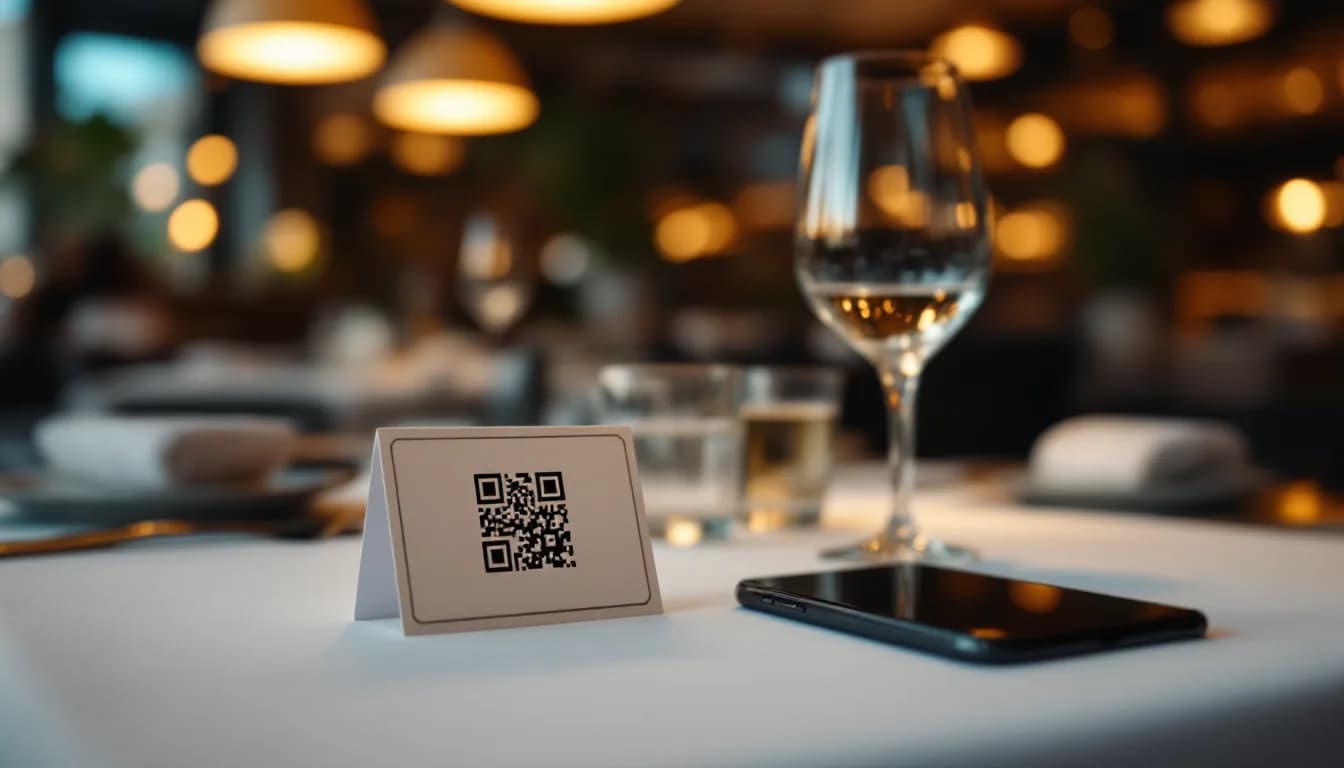
A digital QR menu for hospitality venues works simply: a guest scans a QR code at the table and the menu loads instantly in their browser. No app download, no account creation, no friction.
The operator-side advantage is structural. Allergen data lives in a single cloud-based source of truth — the Backstage dashboard. When an ingredient changes, the operator updates one record and every table's QR menu reflects it immediately. There is no print run to commission, no distribution chain to manage, no risk of a guest reading last month's allergen profile.
This is the core of MUSICDJ CONNECT: a no-download guest web app that surfaces the venue's live menu, enabling guests to browse dishes and their allergen information directly from their own device.
Because there is no printed artefact to become outdated, the gap between what the kitchen is actually serving and what the guest reads collapses to near zero. Version drift — the silent compliance risk that haunts paper-menu operations — is eliminated by design.
For operators concerned about the setup burden of migrating an existing menu, AI-generated menu content is part of MUSICDJ's feature set. It can accelerate the initial data-entry process, reducing one of the practical barriers that sometimes deters venues from making the switch.
Accessibility is an additional benefit worth noting. A mobile-rendered digital menu can support larger text, browser-level translation, and screen-reader compatibility — serving guests with visual impairments or language barriers more effectively than a printed card.
Best Practices for Presenting EU-14 Allergens on a Digital Menu
Compliance requires more than moving your existing menu online. How allergen information is presented matters as much as whether it is present.
Use a consistent visual system. Each dish entry should display its allergen profile in a standardised way — whether through labelled icons, a collapsible allergen panel, or a colour-coded indicator. Guests develop an intuitive reading pattern when the format is consistent across the menu.
Disclose at dish level, not page level. A footer reading 'this kitchen handles nuts' is legally thin and practically useless for a guest evaluating individual dishes. Per-dish allergen disclosure is the gold standard under EU FIC and the approach that genuinely serves guests with serious allergies.
Communicate cross-contamination clearly. Include a cross-contamination notice at an appropriate level of specificity — not as a blanket liability shield, but as genuinely useful guidance for guests who need to assess risk.
Write in plain language. Allergen names should be terms a non-specialist understands: 'milk, including cream, butter, and cheese' rather than ingredient codes or technical terminology.
Formalise a review cadence. Even with a digital system, establish an internal process — triggered by any recipe change and reviewed at regular intervals — where the kitchen team confirms that the digital record matches current recipes. Documenting this process is important: a food-safety inspector who asks how your allergen information is kept current will be more satisfied by a clear, demonstrable internal protocol than by a verbal assurance.
Reinforce with [digital signage for menus and promotions](/solutions/digital-signage). Prominent screens near the entrance or ordering area can display your allergen policy and direct guests to scan the QR code for full dish-level detail — ensuring the information reaches guests before they order, not after.
The Guest Experience Argument: Transparency Builds Trust and Loyalty
Diners with allergies or intolerances — and those accompanying them — increasingly make venue choices based on how confidently and conveniently allergen information is communicated, not just on cuisine type or price point.
The friction guests currently face at many venues is familiar: ask a server, wait while the server checks with the kitchen, receive a laminated allergen sheet separate from the menu. Each step is a reminder that the venue has not prioritised their needs. For guests managing a serious allergy, that friction is not merely inconvenient — it is anxiety-inducing.
The digital QR experience inverts this. The guest arrives at the table, scans, and immediately sees the allergen status for every dish. No waiting, no social awkwardness, no reliance on staff knowledge under pressure.
The group dining dynamic amplifies this effect. When one member of a party has a serious allergy, the entire group's venue choice often defers to that person's safety requirements. A venue that makes allergen information frictionless earns that booking — and frequently earns the repeat booking that follows.
MUSICDJ CONNECT also surfaces a direct link to the venue's Google review profile. Guests who have had a smooth, transparent experience — including feeling confident about allergen information — are more likely to act on that prompt. Positive reviews that mention attentive food-safety practice carry real weight for future guests with similar concerns.
Transparency, in this context, is not a compliance checkbox. It is a positioning advantage in a competitive market.
Operational Wins Beyond Compliance: Staff, Speed, and Fewer Mistakes
Front-of-house staff turnover in hospitality is high, and training every new team member on a complex allergen matrix for a full menu is time-consuming and error-prone. A digital menu that guests can read directly reduces the pressure on staff to function as allergen encyclopaedias during service.
This does not eliminate staff responsibility. Servers must still handle follow-up questions, escalate to the kitchen for edge cases, and take special requests seriously. But removing the first-line recall burden from the service interaction reduces the surface area for error.
The menu-change workflow improves substantially. With a paper menu, a recipe change requires a kitchen-to-management-to-designer-to-printer chain before the guest sees the correction. With a digital menu dashboard, a trained manager can make the update directly and immediately.
The cost trajectory is worth examining honestly. Reprint costs avoided over a year — particularly for venues that change menus seasonally or more frequently — represent a tangible saving. Weighed against the cost of a digital menu solution, the arithmetic often favours the switch within a relatively short period.
On audit-readiness: when a food-safety inspector asks how allergen information is kept current, a venue operating from a centralised digital system can point to a single, always-current source of truth. Paired with a documented internal update protocol — who is responsible, what triggers a review, how kitchen changes are communicated to the person with dashboard access — this provides the evidence trail an inspector needs far more convincingly than a stack of amended paper menus.
Practical Steps to Deploy a Digital Allergen Menu in Your Venue
Step 1 — Audit your current allergen data
Before migrating to any format, the kitchen team must produce an accurate, dish-level allergen matrix. This is foundational. A digital system that replicates inaccurate data is not safer than a paper menu that does the same. Start here, and treat this step as the most important one.
Step 2 — Set up your digital menu on MUSICDJ CONNECT
Create your menu in Backstage, structuring dishes by category and attaching verified allergen information to each item. Where the volume of data entry is significant, the AI-generated menu content feature can accelerate the initial build — reducing the setup friction that sometimes stalls the transition.
Step 3 — Generate and deploy QR codes
MUSICDJ CONNECT produces QR codes that link guests directly to the live menu. Print and laminate these for tables, display them on signage, and consider including them on receipts or booking confirmations so guests can review the menu before they arrive.
Step 4 — Brief your team
Ensure front-of-house staff understand that guests can self-serve allergen information via the QR menu, and that their role shifts toward handling follow-up questions and escalating special requests — not reciting allergen matrices from memory.
Step 5 — Establish an update protocol
Assign clear ownership of menu updates: who is responsible, what triggers a review, and how changes in the kitchen are communicated to the person with dashboard access. Write this process down. A documented protocol is your evidence of due diligence.
Step 6 — Pair with Digital Signage for high-visibility reinforcement
Use digital signage for menus and promotions on venue screens to display an allergen policy statement and a prompt to scan the QR code. This ensures guests are directed to the detailed information before they order — not after a problem has arisen.
When you are ready to move from paper to a system that keeps allergen information accurate, accessible, and always current, get started with MUSICDJ or explore MUSICDJ CONNECT to see how the digital menu works in practice.
Paper Menu vs Digital QR Menu: Allergen Compliance at a Glance
| Dimension | Paper Menu | Digital QR Menu (MUSICDJ CONNECT) |
|---|---|---|
| Update speed after ingredient change | Requires redesign, reprint, and redistribution — hours to days | Single dashboard update; every table reflects the change immediately |
| Version consistency across zones | Each printed copy must be manually replaced; drift is common | All QR codes point to the same live record — one update covers every zone |
| Human error in allergen communication | High: depends on staff recall and supplementary sheets under pressure | Lower: guest reads verified data directly; staff handle follow-up only |
| Cost of menu changes | Recurring: design, print, and disposal costs accumulate with each revision | Included in the digital platform; no per-change print cost |
| Accessibility for guests | Fixed font size and language; no screen-reader support | Supports larger text, browser translation, and screen-reader compatibility |
| Audit-readiness for food-safety inspectors | Stack of amended menus; difficult to demonstrate currency | Centralised, always-current source of truth; a documented internal update protocol provides the evidence trail an inspector needs |
| Guest self-service allergen lookup | Not possible; requires staff interaction | Guests browse per-dish allergen profiles independently via their own device |
| Setup effort | Design and print at launch; repeat for every revision | Initial data entry (accelerated by AI menu generation); updates are self-managed thereafter |
Domande frequenti
Which allergens must EU catering venues disclose under Regulation 1169/2011?
The fourteen allergens mandated for disclosure are: gluten-containing cereals (wheat, rye, barley, oats), crustaceans, eggs, fish, peanuts, soybeans, milk (including lactose), tree nuts (almonds, hazelnuts, walnuts, cashews, pecans, pistachios, macadamia/Queensland nuts, Brazil nuts), celery and celeriac, mustard, sesame seeds, sulphur dioxide and sulphites above 10 mg/kg or 10 mg/L, lupin, and molluscs. These must be disclosed for every dish served in a catering establishment, not just for pre-packaged products.
Is verbal allergen disclosure sufficient for a restaurant or café?
The regulation permits verbal communication as a disclosure route, but only when it is backed by written records that staff can reference. Verbal-only disclosure carries significant risk: accuracy depends on every staff member recalling the correct information under pressure, every time. Enforcement bodies are increasingly scrutinising verbal-only approaches, and in the event of a health incident, the absence of a written record makes the operator's position considerably more difficult. A written or digital record is strongly advisable.
Does EU allergen regulation apply to specials and daily-changing dishes?
Yes. The obligation applies to every dish served, including daily specials and seasonal items. This is precisely why venues that change their menus frequently find paper-based allergen disclosure particularly difficult to manage: every new dish requires an accurate allergen assessment and an update to the information provided to guests before they order.
What is the difference between an intentional allergen and a cross-contamination risk?
An intentional allergen is one that appears as a deliberate ingredient in a dish — for example, peanuts in a satay sauce. A cross-contamination risk arises when an allergen is present in the kitchen environment and could transfer to a dish that does not contain it as an ingredient — for example, tree nuts handled on the same surface as a nut-free dish. EU FIC covers intentional ingredients, but operators are advised to communicate credible cross-contact risks clearly. Failing to do so can mislead allergy sufferers and create both a safety problem and a legal exposure.
Does the UK follow the same allergen rules as the EU after Brexit?
The UK retained an equivalent framework post-Brexit, known as UK FIC. For pre-packed food for direct sale — sandwiches made and sold on the same premises, for example — Natasha's Law introduced additional full ingredient and allergen labelling requirements from October 2021. The scope and some mechanics differ from the EU regulation, and UK operators should consult the Food Standards Agency guidance rather than relying solely on the EU text.
If I use MUSICDJ CONNECT for my digital menu, do I still need to hold a music licence for my venue?
Yes. MUSICDJ's background music service is licensed for business use, but your venue retains its own obligation to hold the relevant local public-performance licence — for example, SOKOJ, GEMA, PRS, SACEM, or the equivalent body in your country. Using MUSICDJ to manage both music and menus from one dashboard does not consolidate or remove that separate regulatory duty.
Make Allergen Compliance a Strength, Not a Stress
MUSICDJ CONNECT gives your guests instant, always-accurate allergen information via a no-download QR menu — and gives you a single dashboard to keep it current. Explore how it works, or create your account today.
Get Started with MUSICDJ